

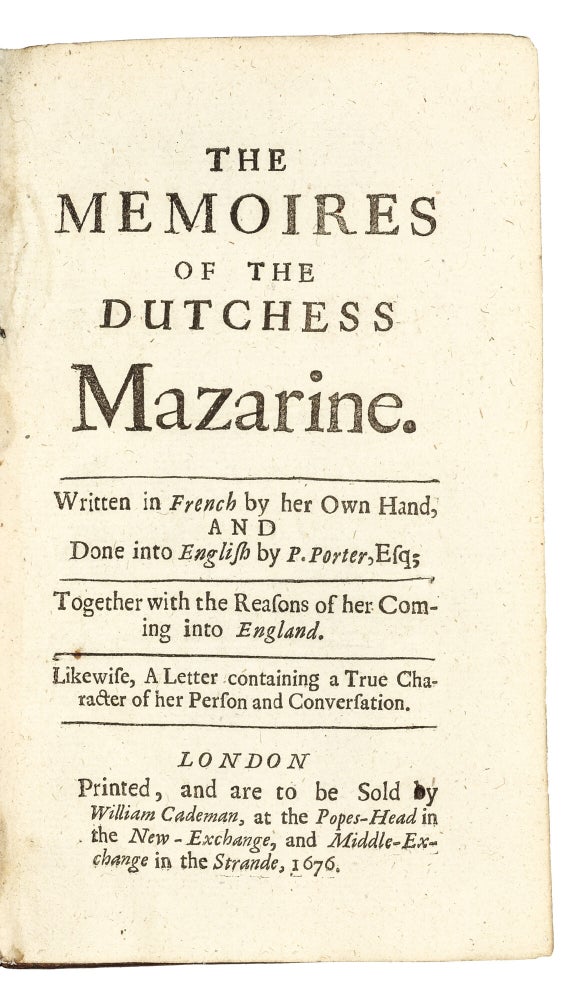


The Memoires of the Dutchess Mazarine. Written in French by her own hand, and done into English by P. Porter, Esq; Together with the reasons of her coming into England. Likewise, a letter containing a true character of her person and conversation.
London: printed, and are to be sold by William Cademan, at the Popes-Head in the New-Exchange, and Middle-Exchange in the Strande, 1676.
Price: $5,500.00
Octavo: 16.5 x 10 cm. [4], 130, [2] pp. Collation: B8, B-H8, I4 (quire A mis-signed B) Complete.
FIRST EDITION IN ENGLISH, a re-issue, printed in the same year, of ESTC R28396 (Wing S355).
A fresh, crisp copy, bound in original 17th c. sheep (corners bumped, wear along the hinges, a few small scrapes) with a later label (chipped). The contents are in very fine condition, with just a small nick in the blank margin of C7, creasing to a few leaves, a bit of staining in the inner margin, and a little soiling to the inner blank margin of the title page. License leaf and errata both present, pasted to the later free end-papers. With the bookplate of the Earl of Ilchester. The portrait, found in the Folger copy, is the source of its addition to the ESTC record. I have examined the portrait and it is a later insertion. While Peter Lely did paint the portrait of the duchess from which the engraving is derived, the Dutch engraver, David Coster, was not born until sometime between 1675 and 1686 (See RKD, Netherlands Institute for Art History).
The memoirs of the noblewoman Hortense Mancini, niece of Cardinal Jules Mazarin, who fled an abusive marriage and sought refuge in various countries before eventually settling in England, where she became the mistress of King Charles II and established herself in English society. Although her affairs, including an alleged affair with Anne, Countess of Sussex, caused scandal, she was well-regarded and admired by many, including Aphra Behn. Upon the death of Charles II, she was still welcome at the court of James II and her cousin, Mary of Modena.
Written after her emancipation from her domineering husband, the memoirs are Hortense’s effort to defend her reputation against rumors and accusations of alleged transgressions, including adultery. First printed in French in 1675, the memoirs became immensely popular. This English edition appeared the year after Hortense’s arrival in England.
“Hortense Mancini, the niece of [Cardinal Jules] Mazarin and the younger sister of Louis XIV's first love, Marie Mancini, was said to be one of the most beautiful and charming women of the seventeenth century. Her Mémoires were probably written in Chambéry, where she was living under the protection of Charles-Emmanuel II, duc de Savoie, to whom they are addressed. Many scholars believe, however, that their author was not Hortense, but the abbé de Saint-Réal who based them on conversations with her. Literary creation was often a social pastime of aristocratic women, and it was common for them to entrust their efforts to secretaries, who were better versed than they in the rules of spelling and grammar. When the text thus produced was an autobiography, it became extremely difficult to determine whose truth was being told—the woman's or the secretary's.
“The Mémoires may be roughly divided into two parts. In the first, the author justifies her separation from her husband; in the second s/he describes the problems she encountered as a renegade wife and refutes the rumors spread about her…
“Her story may be briefly summarized as follows: Summoned from Italy at a young age by her uncle Cardinal Mazarin, she spent her childhood at the French court, where she was for all intents and purposes a member of the royal family. Mazarin married her when she was fifteen to the duc de Meilleraye, who became, by the provisions of the Cardinal’s will, the inheritor of his name and fortune. The marriage proved to be a disaster. Her husband was insanely jealous. The narrator writes that because he was afraid to let her out of his sight, he insisted on dragging her back and forth across France, even when she was in the last stages of pregnancy. He destroyed a stage-set she had constructed for a theatrical entertainment, discharged her servants, refused to speak to her until she removed her beauty marks, and blocked up the passage between their living quarters and those of her brother Philippe.
“Worse still, driven by religious scrupulosity, he squandered Cardinal Mazarin's vast fortune, which he considered ill-gotten gains, and then confiscated the jewels that constituted Hortense's only personal wealth. Arguing that he had acted illegally and that he had jeopardized their sons' inheritance, she demanded a separation, which was granted on condition that she be confined to a convent. After a series of highly publicized disputes and legal maneuvers, Hortense decided to leave Paris and join her sister Marie, now married to the Connétable Colonna and living in Rome. Her subsequent peregrinations and adventures gave rise to scandalous gossip, fanned by her husband.
“She was accused, among other things, of having had incestuous relations with her brother, of becoming pregnant by a gentleman in her retinue named Courbeville, and of having affairs with almost every man she met. The Memoires deal with these reports in several ways. Sometimes they indignantly deny them outright. Sometimes they offer plausible explanations. And frequently they omit any reference to them at all…
“The author, who may or may not have been Hortense, immediately foregrounds the problem inherent in such a project:
“It's not that I don't know how difficult it is to speak about oneself wisely; and you are not ignorant either of my natural repugnance for explaining myself about things that concern me: but it is still more natural to defend oneself from slander; at least to those who have been of great service to us. They certainly deserve to be informed that one is not altogether unworthy of having been their recipient... if what I have to tell you seems much more like a novel, blame my bad fortune, rather than my inclination.”
Then follows the oft-cited aphorism summing up the aristocratic ideal of feminine conduct: "Je sais que la gloire d'une femme consiste à ne faire parler d'elle" (32: I know that a woman's glory lies in not getting herself talked about). Not getting herself talked about has clearly not been the case for Hortense, of whom a great deal has already been said, and of whom a great deal more will probably be said as the result of this apology. This opening statement casts her, therefore, in the role of transgressor-the woman who has gotten herself talked about, and who now defies the rules governing a lady's conduct in order to set the record straight….
“[The Memoires] contain novelistic elements, such as clandestine escapes, perilous journeys, and transvestite disguises. The account of her girlhood at court, as well as many of the more amusing anecdotes, represent her as a high-spirited individual with a penchant for merry pranks. The narrator tells of how, during one of her enforced stays in a convent, she and Mme de Courcelles tried to wash their feet and ended up inundating the nuns in their beds on the floor below. Another time, she says, they hid in the parlour behind a grill, from which Hortense proved too plump to escape. She also had a flamboyant sense of fun. She loved to play blind-man's bluff and sometimes indulged in rough horseplay, once injuring her knee so badly that her leg nearly had to be amputated. At times the narrative voice becomes flip-pant, if not downright irreverent.”(Cholakian, Sex, Lies, and Autobiography: Hortense Mancini's Memoires, in Women writers in pre-revolutionary France: strategies of emancipation, 1997).