



Todten-Tantz, wie derselbe in der löblichen und weitberühmten Stadt Basel als ein Spiegel menschlicher Beschaffenheit gantz künstlich gemahlet und zu sehen ist. Mit beygefügten aus H. Schrifft und denen alten Kirchenlehrern gezogenen Erinnerungen vom Todt, Aufferstehung, Jüngsten Gericht, Verdamnuss der Gottlosen und dem ewigen Leben. Nach dem Original in Kupffer gebracht und heraus gegeben durch Matth. Merians sel. Erben
Frankfurt: Heirs of Matthäus Merian, 1696.
Price: $9,500.00
Quarto: 20 x 16 cm. 206 pp., [1] leaf. Collation: A-Z4, Aa-Cc4
SECOND EDITION THUS. Fifth edition overall. This edition is based on Merian’s own 1649 edition, which was the first to include these revised images and a number of the supplementary texts.
Bound in original tanned sheepskin (light surface wear, corners bumped, lower edge of rear board abraded), faithfully and almost imperceptibly rebacked, the new spine richly tooled in gold and with a red morocco label. Internally an attractive copy with minor soiling and discoloration to margins of the title page, scattered mild soiling in the text (mainly marginal), a few small rust spots and light blemishes, a discreet contemporary repair to one blank margin, a small tear in the margin (no loss) of leaf G1, a clean tear barely entering the image (no loss) on leaf M1; Memento Mori plate lightly soiled. There is a curious feature in this copy: there is light offsetting -from the text of different book- on one side of the 3 sheets that made up gatherings H, S, and Cc, probably the result of those sheets having been laid upon sheets of the other book while still damp. With the collector’s stamp of Johann Carl Conrad Oelrichs (1722–1798) on the title verso.
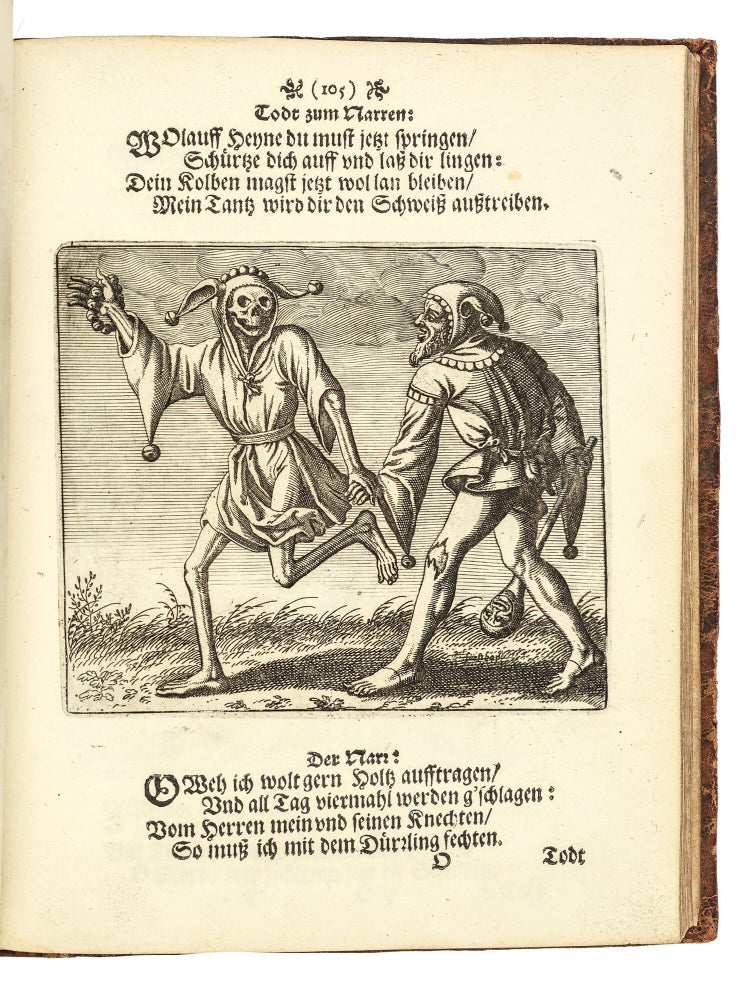
A series of engravings, with accompanying text, by Matthäus Merian the Elder, depicting the Grossbasler Totentanz, the 60-meter long Dance of Death mural, painted circa 1439, which adorned the inner face of the cemetery wall adjoining the Dominican convent and Predigerkirche in Basel. It was, along with the Danse Macabre murals painted in the arcades of the Paris Cimetière des Innocents, one of the two earliest painted Dance of Death fresco cycles. The Basel frescoes were lost in 1805 when the wall was destroyed. Only 19 fragments survive.
The murals depicted a communal dance between cadavers and people from all strata of society, from pope to peasant, including members of various trades and professions, from physician to fool. The list of those who join -unwillingly- their macabre dance masters in this dance to the grave are, in order of appearance: pope, emperor, empress, king, queen, cardinal, bishop, duke, duchess, count, abbot, knight, lawyer, councilman, church canon, physician, nobleman, noblewoman, merchant, abbess, lame man, hermit, young man, usurer, maiden, minstrel, herald, mayor, executioner, fool, peddler, blind man, Jew, heathens (a man and a woman), cook, peasant, painter, and a mother holding her child. The dance is preceded by the images of a preacher delivering a sermon and a group of skeletons emerging from a charnel house playing instruments (this image was probably added over the actual ossuary in the cloister during the restoration of 1616.) “The figures of Death were depicted in all kinds of contortions, suggesting movement and presumably intended to evoke an association between the represented action and the variety of dance being performed, particularly round dances (Reigen), popular at that time. This is all the more probable because the introductory part of the dance of death (which did not survive) quite likely depicted figures of Death making music.”(Dreier, Der Totentanz, p. 47)
“Beneath the pictures was a band containing addresses by Death and replies by the individual representatives of the estates, each of four lines in Basel or eight lines in Paris. These verses were written in the local idiom, generally in iambic rhyming couplets or alternating rhyme. In the verses, the encounter between Death and the human representative was cast as a dialogue in which Death reminded human beings that, in the face of mortality, everything worldly was transitory and vain…. Following Erwin Koller’s outstanding philological investigations… it may be assumed that the blockbook produced in Basel around 1460, now preserved in Heidelberg University Library under the shelfmark cpg 438, is a contemporary, virtually identical transcription of the original Basel text.”(Dreier, p. 48)
Merian made his engravings based on his drawings of the Basel frescoes in 1616. He then either gave or sold his engravings to his nephew, Johann Jakob Merian. The first two editions appeared in 1621, one of them printed by Johann Schröter, the other by Matthäus Mieg, who re-published the book in 1625. The artist himself reworked the plates in 1649, adding atmospheric elements and background details, and printed them with a greatly expanded text. This 1696 edition by Merian’s heirs reprints the images and text of that edition.
For the 1649 expanded edition, Merian added a 10-page history of the Basel mural, the now-iconic Memento Mori engraving (an hourglass with a skull, a burning candle, and wilting flowers), the Adam and Eve engraving, and the dual-portrait engraving (which, when viewed right side up, shows a bearded man, and when turned upside down, show a death’s head.) Merian also added, as announced on the title, 42 pages of “Admonitions concerning Human Mortality, the Fleeting Nature of This Present Life, and the Vanity of All Earthly Things; concerning the Burial and Resurrection of the Dead; concerning the Last Judgment; concerning Hell and the Damnation of the Godless; and concerning Eternal Life.”.
Wüthrich, Das druckgraphische Werk von Matthaeus Merian d. Ä., III, 5, 5; Massmann p. 77, No. 5 (III. 1 b/5). For further reading: Dreier, Rolf Paul. Der Totentanz – ein Motiv der kirchlichen Kunst als Projektionsfläche für profane Botschaften (1425–1650). PhD diss., Erasmus Universiteit Rotterdam, 2010