

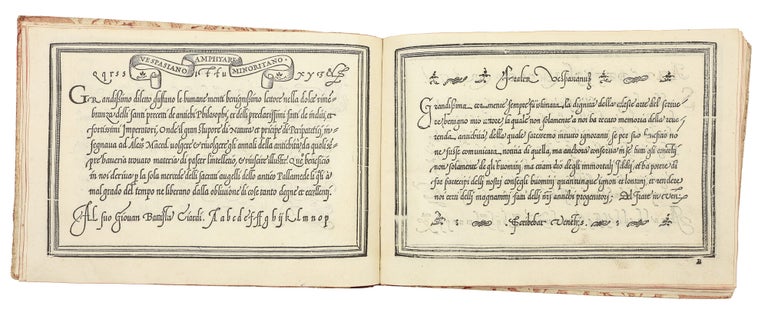


Opera di Frate Vespasiano Amphiareo da Ferrara… nella quale s’insegna scrivere varie sorti di lettere
Venice: Alessandro Gardano, 1580.
Price: $9,800.00
Oblong format: 20.7 x 15 cm. [56] lvs. Collation: A4, A-F8, G4
THIRTEENTH(?) EDITION, first printed in 1548. All editions are rare.
Bound in 18th c. paste-paper over boards with a slim red morocco spine (light wear to boards and spine, upper joint starting, corners bumped). A very nice copy, preserving earlier endpapers with a 17th c. ownership inscription and a calligraphic flourish. The volume is overall very fresh with just a very light stain to the inner margin of the first few leaves, light soiling to the title (with two early ownership inscriptions) and last leaf, some scattered marginal soiling, and a few small stains on two leaves. Illustrated throughout with 101 pages of woodcut alphabets and writing examples.
An influential writing manual by the Franciscan friar and writing master Vespasiano Amphiareo, who practiced and taught calligraphy in Florence before moving to Venice around 1518. In the introduction to the first edition of his book (1548), he tells us that he had already been practicing his craft for thirty years.
The book showcases Amphiareo’s “bastarda del frate” script, which combined elements of the mercantile and chancery hands to produce a more fluid form that would serve the needs of both the chancery scribe and the merchant, as well as non-professional letter writers. As the author writes in his dedication to Prince Francesco Donato, the Doge of Venice, “Having, through my own art and industry, newly devised a form and a character of handwriting called bastarda, which, like a mystical body of nature, partakes of many [styles of writing], it seems to me that it may be equally suited to the chancery scribe, because it is somewhat elongated and graceful, and useful to the merchant, because it is cursive and swift; and therefore to every other sort of person.”
The book first appeared in 1548 and went through no fewer than 18 editions—with the addition of two new scripts after 1572—up to the year 1620. In addition to the writing examples (which occupy 101 pages), Amphiareo includes instructions for making black, blue, red, and gold inks; as well as instructions for making and holding a pen. Amphiareo’s was the first writing book in oblong format, designed to better reflect the dimensions of writing paper, rather than the vertical format used by printers.
In his letter to the reader, Amphiareo explains how he developed his script: “For many years I had it in mind to find a form of letters so easy and quick that both chancery clerks and merchants could write it readily, and that would fully serve them for letters, and for keeping books. This inclination of mine was greatly spurred on by men of outstanding intellect in Florence, at the time when I was pursuing my usual occupation in that most illustrious city.
“There, a certain mercantile letter with heavy strokes was in use, not very unlike the Venetian mercantile. Since it was difficult and slow both to write and to learn, I set myself to study and sharpen my wits so much that I adapted certain bodies and certain strokes of the one and the other letter. In the judgment of men of understanding, my idea turned out gracefully. This letter, which I named the Bastarda del Frate, was so welcome and so praised that in the said city of Florence, fathers would not have their sons learn any other letter. This proved a success both for them and for me, since they learned to write with the highest excellence, and I drew no small profit from it. Because my intention is to share with all the world the skill that God has given me, and I cannot be bodily in more than one place, I have had this present little book engraved at incredible expense to myself.”
In addition to the bastarda, chancery, and mercantile hands, Amphiareo includes “a number of gothic hands: bollatica, francesca, rognosa, etc., all in appropriate texts; a number of alphabets: ornate roman capitals signed in interlaced ciphers of the sort expounded by Palatino, followed by a set of decorated roman capitals made up of twisted boughs or logs; a handsome set of gothic entrelac initials, two to the page, decorated with putti, heads, and the like; a decorated gothic set, also two to the page; a set of simplified geometrically constructed minuscules, round gothic, based on Fanti's; and roman inscriptional outline capitals, against horizontally ruled squares…
“Amphiareo's choice of format was also a significant change. The books of his predecessors, from 1514 until his own, had all been vertical octavos, apart from Tagliente's one (perhaps abortive) experiment in this format in 1525. Their layouts were modeled on book practice. Amphiareo's format showed off to best advantage his layouts, inspired not by book pages but by epistolary practice. The letter of his day was generally written on a wide, short sheet of paper or vellum, folded after writing to produce an envelope - somewhat on the order of today's airletter form turned sideways. Amphiareo's pages suggest this shape quite successfully."(Morison, “On Some Italian Scripts of the XV and XVI Centuries” in “Selected essays on the history of letter-forms in manuscript and print”, Vol. 2, Ch.8, p. 89 ff.).
Bonacini, Bibliografia delle arti scrittorie e della calligrafia, 59; Ornamentsichslg. Berlin 5183; The standard bibliography is Johnson, A Catalogue of Italian writing-books of the sixteenth century, in Signature: a quadrimestrial of typography and graphic arts, new series, volume 10 (1950). For other editions, see Marzoli, Calligraphy 1535-1885, nos 4 and 5; Walters Art Gallery, 2,000 years of Calligraphy, Baltimore, 1962, no. 67; Becker, The practice of letters: the Hofer collection of writing manuals 1514-1800, nos 18-22; For a reproduction of the 1554 edition, see Tschichold, “Das Schreibbuch des Vespasiano Amphiareo : vollständige Nachbildung in voller Grösse = Vespasiano Amphiareo's writing book, Vinegia 1554.” Not in BMC STC Italian, Adams, or Mortimer.