

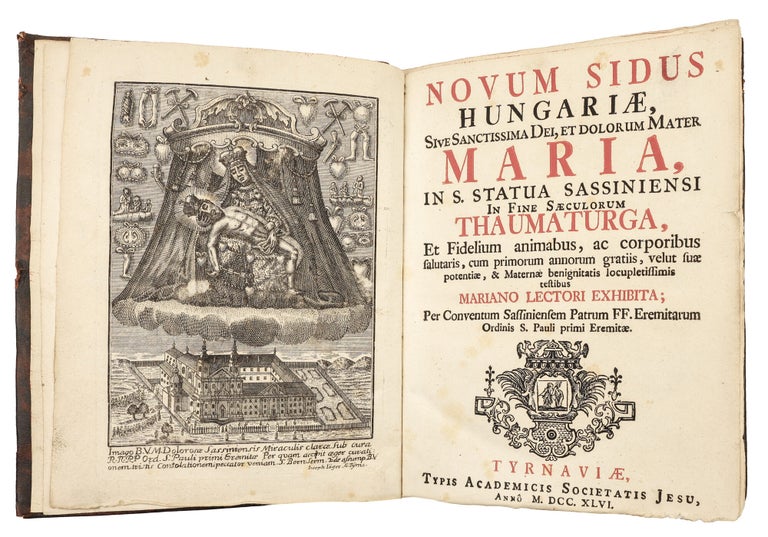


Novum Sidus Hungariae, sive Sanctissima Dei, et Dolorum Mater Maria, in S. Statua Sassiniensi in Fine Saeculorum Thaumaturga, et Fidelium animabus, ac coporibus salutaris, cum primorum annorum gratiis, velut suae potentiae, et Maternae benignitatis locupletissimis testibus Mariano Lectori exhibita; per Conventum Sassiniensem Patrum FF. eremitarum Ordinis S. Pauli primi Eremitae.
Trnava [Nagyszombat in Hungarian]: Typis Academici Societatis Jesu, 1746.
Price: $3,800.00
Quarto: 20 x 15.2 cm. [8], 326 p. A-Z4, Aa-Rr4, Ss2 (final leaf S4 is blank and present)
FIRST EDITION.
Bound in full original sponged sheepskin, the spine tooled in gold and with a later black label (small defects and light wear to the binding, gilding muted.) A very good copy, complete with the engraved frontispiece showing the icon. The opening leaves are slightly worn at the edges; the engraving has some light spotting; there is slight worming to inner blank margin of front half-title, engraved leaf, and title (not affecting the image or text). Very rare, I have located only one copy in North America (Dayton).
A rare history of a miraculous statue of the Virgin Mary as Our Lady of Sorrows at Sasvár in western Slovakia, featuring dramatic accounts of supernatural cures attributed to the icon, scenes of witchcraft, apparitions, visions, disembodied voices, and miracles. The book was printed at the Jesuit Academic Press in Trnava, in present-day Slovakia. The engraved frontispiece of the icon is by Joseph Jäger (Jozef Jáger), active in Prague and Trnava from at least 1728, who specialized in devotional prints such as this one.
In the engraving, the icon is surrounded by small votive offerings of the sort left by those who hoped to be cured of their afflictions: models, in wax or silver, of ears, eyes, hearts, breasts, limbs, and pistols (symbolizing gunshot wounds.) The text includes a number of descriptions of these sorts of votives. In one instance, a father presents a bone encased in silver following his daughter’s reported recovery, while others offer representations of afflicted body parts, clothing, devotional images, or money.
The author, the Pauline monk Gellért Jankovich, organized the miraculous cures by year and affliction. The subjects include children suffering from seizures, smallpox, and witchcraft; difficult childbirths, wounds, dangerous falls, and near drownings. These accounts commonly specify places, family members, and circumstances.
Some accounts describe unsuccessful medical treatment before the sufferer appealed to Our Lady of Sorrows, sometimes identifying the physicians or surgeons involved and their fees; in one case a kidney stone is cut out by a surgeon, yet the compiler credits the boy’s recovery to the Virgin. (252-253)
Witchcraft:
The chapter “Maleficium, Mariana potestas destruit” (“The Power of Mary Destroys Witchcraft”) recounts the supposed bewitchment of Anna Kurill, a Moravian who lost the use of her legs. After numerous remedies failed, Kurill appealed to Our Lady of Sorrows at Sasvár. According to the author, the diabolical influence vanished and she regained the ability to walk. Kurill subsequently made the pilgrimage to Sasvár accompanied by two witnesses, where she testified to her recovery before a Pauline priest. (161-162)
The statue Our Lady of Sorrows at Sasvár was erected following a quarrel between Count Imre Czobor and his wife Angelina Bakvics in 1564. After her husband ordered her and her attendant out of their carriage, stranding them, Angelina prayed to Our Lady of Sorrows and vowed to erect a statue in her honor if they were rescued. Count Czobor sent his carriage back for Angelina, and she fulfilled her vow by having a Pietà placed on a triangular column beside Sasvár Castle (2–3). Following reports of miraculous cures attributed to the Pietà, a cult developed around the statue, and pilgrimages to the shrine began in the 16th and 17th c.
In 1718, access to the statue was restricted, but in 1732 the townspeople broke into the enclosure during a procession to reach the column. Reports of recoveries and extraordinary lights led the local Archbishop to order the statue removed to ecclesiastical custody and the reports investigated under oath. This book summarizes testimony given during the investigation and reproduces the archiepiscopal decision authorizing restoration of the image to public veneration (6-25). The following November, a procession reportedly attracted more than 25,000 people. The shrine required a larger church and better facilities, and construction began in 1736. It was consecrated in 1762 in the presence of Empress Maria Theresa, who had contributed to its development.
The final chapter recounts punishments attributed to the Virgin for unfulfilled vows and the misuse of offerings: a woman who gave the chapel only three of the ten florins her husband had told her to give was seized with anxiety on her way home and could not rest until she returned and paid the rest, and a woman from Skalica who stole a coin or medal hanging from the Virgin’s rosary was struck with trembling and weakness until she brought it back. (324-326).