

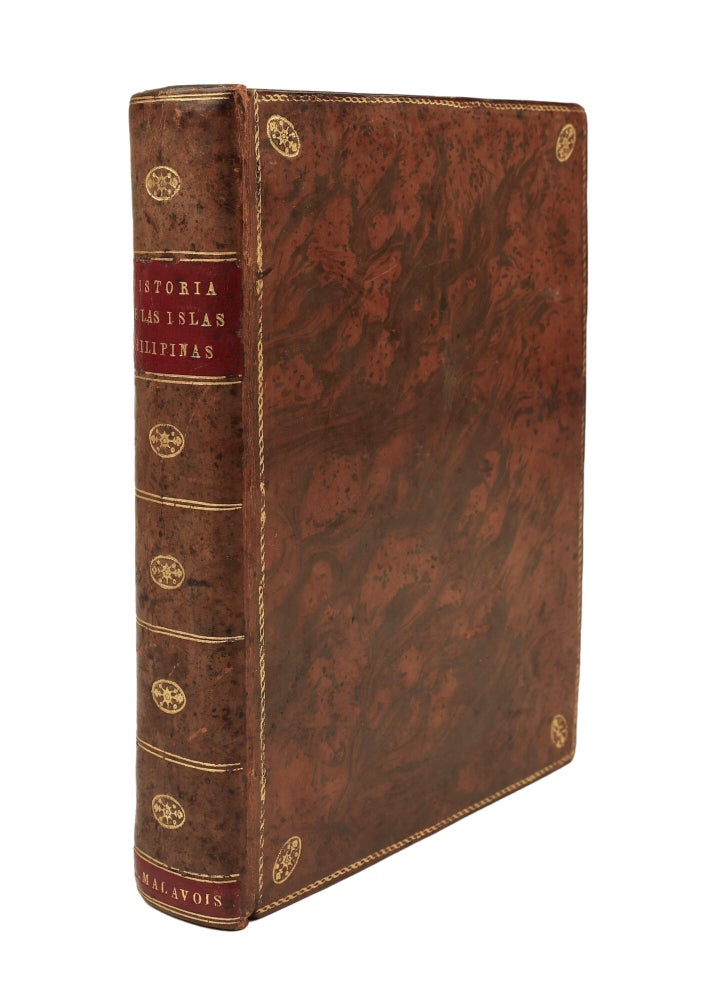


Historia de las Islas Philipinas.
Sampaloc: Por Fr. Pedro Arguelles de la Concepcion, Religioso Francisco, 1803.
Price: $11,500.00
Quarto: 20 x 15.7 cm. [2], [7], 687 pp. A-Z4, Aa-Zz4, Aaa-Zzz4, Aaaa-Oooo4
FIRST EDITION.
An excellent copy bound in later treed calf, boards decorated in gilt, spine gilt and with contrasting lettering piece, with a name label stamped in gilt ‘Al. Malavois’ at foot of spine. Printed on Chinese laid paper ("rice" paper); historiated initial, tail-piece. Internally very fresh and clean with just two tiny wormholes (not affecting text) to the blank margin of the first three leaves. Extremely rare. I have traced 2 copies in North America (LC, JCB).
Printed at Sampaloc, Manila, this book presents a comprehensive history of the Philippines from Magellan’s arrival in 1521 through the British occupation of Manila and the restoration of Spanish governmental control in 1764. Zúñiga, an Augustinian missionary, discusses Filipino culture (including religious, marriage, and funeral customs), language, slavery (as practiced by the Filipinos) and the abuse of Indigenous laborers by the Europeans (which the oppressed resisted with armed rebellion), missionary activities, natural history, and trade with Mexico and with other Asian regions. He incorporates his own experiences and observations, including his ascent of Taal volcano.
Zúñiga served as a missionary in the Philippines from 1786 until his death in 1818. He drew on earlier histories, supplementing them with documentary sources and his own observations. In his preface, he explains that he wrote to make Philippine history accessible in a concise work and to correct distorted accounts of earlier events. He criticizes earlier historians’ bias, attributing their differing interpretations to their loyalties and interests. He dismisses their accounts of satyrs, people with tails, and merfolk and omits reports of unusual natural phenomena that he could not substantiate, suspecting that his predecessors preferred “the marvelous to the true, as though they were writing poems.” (17)
Drawing on years of firsthand experience in the Philippines, Zuñiga presents a vivid portrait of Indigenous culture. His account of marriage customs includes payments made by the bridegroom, divorce, and wedding ceremonies involving the sacrifice of a pig, feasting, and dancing. He describes priestesses known as babailanas or catalonas, offerings to ancestral spirits believed to inhabit trees and rocks, and rituals associated with illness and childbirth. Burial customs included placing clothing, weapons, and food with the dead and leaving an empty seat for the deceased at a subsequent meal. In discussing the legal system, he tells of ordeals in which suspected thieves were required to retrieve a stone from boiling water (those who failed had to pay a fine in gold).
Zúñiga discusses slavery in Indigenous society and abuses under the encomienda system; he condemns colonists who believed that Indigenous people “owed them service as slaves” (p. 155). He also recounts a rebellion by laborers compelled to cut timber, describing their low pay, forced removal from their communities, and beatings.
The narrative recounts European voyages, Spanish settlement in the Philippines, and colonial expansion beginning with Magellan’s arrival in 1521 and continuing through the settlement of Cebu and establishment of Manila. A brief account follows Sir Francis Drake’s voyage through the Strait of Magellan and his stay on the California coast. Zúñiga describes the Philippines’ commercial dependence on Mexico through the Manila-Acapulco trade, which carried Chinese silks, porcelain, and other Asian goods to Mexico in exchange for silver. He also examines the difficulties of missionary work in his own time, including shortages of missionaries, isolated stations, inadequate stipends, and delays in payment. The book includes an extensive history of Catholic missions in the Philippines, China, Japan, Tonkin, the Marianas, and the Carolines, alongside accounts of wars with neighboring powers and resistance to Spanish rule. The concluding chapters give an extended account of the British occupation of Manila, provincial resistance under Simón de Anda, and the restoration of Spanish government in 1764.
Seeking a link between the languages of Chile and the Philippines:
Zúñiga compares Tagalog with Mapuche, an Indigenous language of Chile, in “the earliest-known publication to establish anthropological and linguistic comparisons between the ancient Mapuche language and the Tagalog language of the Philippines”. (Danel 49). He compares pronouns, numerals, vocabulary, and grammatical structure, arguing that languages spoken from Madagascar across the Pacific are dialects of a common language. He acknowledges, however, that the Chilean comparison requires further evidence before a common linguistic origin can be established. He draws on vocabularies collected by voyagers and tests the Pacific comparison through a linguistic examination with an Englishman and his servant from the Sandwich Islands, finding similarities with Philippine languages in grammatical structure as well as vocabulary. He also describes Indigenous writing, including points placed above and below consonants to indicate vowels.
Pardo de Tavera, Biblioteca Filipina, 1631; Palau, 156322; Medina, Manila, 390;
Dindinger, Bibliotheca Missionum IX--16; Library of Congress, List of Books on the Philippine Islands, p. 49.; Lopez Museum 766; Danel, Andrea Ballesteros. “The Philippines (and Chile) in Martínez de Zúñiga’s 19th-Century Ideas about pre-Columbian trans-Pacific Contact”. The Journal of Pacific History, Volume 60, No.1 (2024), pp. 48-69.