

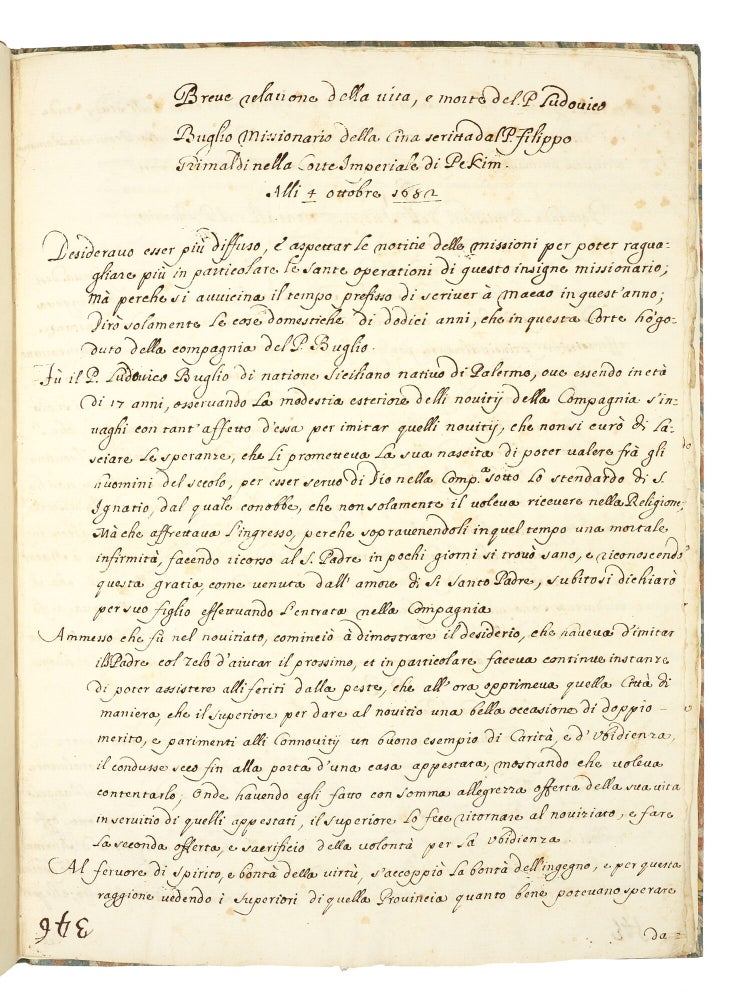


Breve relatione della vita e morte del P. Ludovico Buglio, Missionario della Cina, scritta dal Padre Filippo Grimaldi nella Corte Imperiale di Pekin. Alli 4 ottobre 1682.
[Rome?]: ca. 1683.
Price: $24,000.00
Folio: 28.3 x 21 cm. [10] pp. (6 unnumbered leaves, the last blank)
Bound in modern marbled papered boards with leather title label in gilt to the upper board. 17th c. manuscript in ink in a fine secretarial hand, on laid paper with watermark of an anchor within circle. Fine condition, leading edge untrimmed. A little light spotting on the first leaf, very slim portion of leading edge of fourth leaf a little ragged and dust soiled.
A report on the life, death, and funeral of the Sicilian Jesuit Ludovico Buglio (1606–1682), called Li Leisi (Chinese: 利類思), a distinguished missionary and scientist at the Chinese imperial court in Peking during the late Ming and early Qing dynasties. It was written by Buglio’s fellow Jesuit and friend Filippo Grimaldi (Chinese: Min Ming’o, 1638-1712), who arrived in China in 1671. Grimaldi was present at his confrère’s funeral, where he tells us that he partook of Manchu tea and wine offered to the mourners.
This account, which contains information not reported elsewhere, remained in manuscript until the 20th century. In addition to our manuscript, three other copies are known, one of them in the Jesuit archives, Rome: Fondo Gesuitico, A.R.S.I. (Archivum Romanum Societatis Iesu), 722/4; another in the Vatican: A.S.V. (Archivio Segreto Vaticano), Miscellanei dei Gesuiti, arm. VIII, 58, ff. 16r-21v; and the third in the State Archives, Rome: Archivio di Stato, Roma, Gesuiti, Miscell. Pacco 5.
Ludovico Buglio labored in China for forty-seven politically turbulent years. He established the first mission in Szechwan (Sichuan) Province, where he carried out intensive evangelization despite opposition from local Buddhist and Daoist clergy, built churches at Baoning, Chongqing, and Peking, served as astronomer for the rebel Zhang Xianzhong (who raised Buglio to the rank of mandarin), and was instrumental in restoring the Imperial Observatory at Peking to Jesuit control.
Buglio was imprisoned twice, exiled once, and narrowly escaped execution. An arrow wound inflicted by a Manchu warrior in 1647 never fully healed, leaving Buglio in intense pain for the rest of his life. The wound ultimately proved fatal. In a letter (transcribed in this manuscript) addressed to Buglio’s fellow Jesuits in Peking, the Kangxi Emperor lamented Buglio’s prolonged suffering and imminent death, and announced that he would assist with the funeral expenses. The Emperor’s letter is followed by Grimaldi’s eyewitness account of the funeral, which was overseen by imperial delegates, who also participated in the traditional Chinese funeral honors.
Renowned for his mastery of spoken and written Chinese, Buglio wrote and published a large number of Chinese-language works, a list of which is appended to this manuscript. Among the most important of these were "Yulan Xifang Yaoji" ("Imperially Commissioned Essentials of the West"), presented to the Kangxi Emperor around May 1669, and a translation of Aquinas’ “Summa Theologica” titled “Chaoxing xueyao” ("Compendium of the Science of the Supernatural").
The author and his account:
Grimaldi “was one of the most capable and courageous missionaries; he arrived in China during a time of persecution when, with the exception of four Fathers remaining in Beijing, the other missionaries had been rounded up and held prisoner in Canton (twenty-five in total: fourteen Jesuits, ten Dominicans, and one Franciscan). Upon arriving in Macau, the young Fr. Grimaldi secretly made his way into Canton in December 1669 to take the place of a missionary—Fr. Navarrete, the Dominican superior—who had escaped from prison; his absence, had it been discovered, could have seriously jeopardized all the prisoners. In 1671, when the missionaries in Canton were released, Fr. Grimaldi was summoned to Beijing to assist Fr. Verbiest and gave science lessons to Emperor Kangxi himself. In 1685, the Emperor sent him to Russia to negotiate with the Tsar regarding the passage of Chinese merchants and European missionaries through Russian territory; however, he was unable to achieve this objective, and after an absence of seven years, he returned to Beijing, where he died in 1712.”(Barbera)
Grimaldi was well-positioned to write this account of Buglio’s life. He labored alongside Buglio for twelve years, and it can be assumed that those things that Grimaldi did not witness personally were communicated to him by Buglio himself and other Jesuits, chief among them Buglio’s close companion Gabriel Magalhães, who was with Buglio from the time of his work in Sichuan province through his time in Peking. This accounts for the level of detail that Grimaldi is able to present in his account, such as in the story of the providential removal of the arrow that had become lodged in Buglio’s body after he and Magalhães were mistaken for spies and shot by Manchu soldiers: “a piece of arrow so tenaciously lodged in his body that Father Magalhães was never able to draw it out, either with his hands or with his teeth. Magalhães, though he was gravely wounded in one arm, strove to find in the wilderness something with which to draw the arrow out; and behold, before his eyes there appeared a pair of pincers, which seemed to have been brought by his guardian angel for that very need alone, with which, full of joy and wonder, he gave thanks to divine providence and freed Father Buglio from that affliction.”
The Emperor’s letter & Buglio’s Funeral:
While Buglio lay on his deathbed, the Emperor, having heard about Buglio’s illness through Zhao Chang, a member of the Imperial Bodyguard, sent a letter to the Jesuits, which Grimaldi gives in full. In appreciation for Buglio’s years of service to his father and himself, his dedication to Chinese language and culture, and “because you are men from beyond the sea, and Father Ludovico now lies dying in this city, far from his own country, without kinsfolk to assist him”, the Emperor informs the Jesuits that he will arrange and pay for Buglio’s funeral. With the letter comes a gift of “two hundred Foè (that is, two hundred gold scudi) and ten pieces of silk, as a token of the regard I have held for the father, and of how greatly his loss grieves me.”
The funeral rites included an impressive procession:
“The Emperor in every way wished the funeral conducted according to his own affection, and not according to the modesty proper to our institute. Twenty soldiers were sent by the Emperor to clear the streets as far as the burial place… At the head of the procession walked a standard raised aloft, on which was written, in large characters, the Father's name, together with the many praises and honors the Emperor bestowed on him, and a copy of the Emperor's own letter in praise of the deceased, on yellow satin silk (a color reserved to His Majesty alone). There followed Father Buglio’s image, above which were written two very large characters signifying that this imperial decree had been issued in memory of the great esteem in which the deceased had been held. In the place of highest honor was set the Holy Cross, with the images of St. Michael and Our Lady, amid many censers and incense, and choirs of diverse musical instruments.”
“Then followed more than five hundred Christians, clothed in mourning, and finally gentlemen without number, preceded by the court officials sent by the Emperor for this purpose. This whole procession having at last arrived at the place granted us by the late Emperor for the burial of the fathers, the funeral was carried out — with great modesty on the part of the Christians and equal reverence on the part of the gentiles…”
Grimaldi closes his account explaining that while he would like to write more, the letter courier is about to leave for Macau and so he must stop where he is.
The list of Buglio’s Chinese Works:
Grimaldi applauds Buglio’s remarkable success in mastering Chinese, which allowed him to forge close relationships with the Chinese literati and the mandarins. “He accomplished much by writing…understanding very well how highly letters are prized in China, and how gentle and how powerful a means the spreading of books is for instilling the holy law of Christ. From the very beginning of his arrival in China he lost no time in advancing himself in Chinese letters, language, and books, and to this end he had all the walls of his room covered with Chinese characters.”
The manuscript closes with a list of 23 of Buglio’s Chinese works, including the aforementioned "Yulan Xifang Yaoji" and “Chaoxing xueyao” as well as translations of the Roman Missal (1670), Breviary (1674), and Ritual (1675). Other works, some on scientific matters, addressed to the Emperor include “Shizi shuo” ("Discourse on Lions," 1678), written when the Portuguese gave the emperor an African lion, based largely on Ulisse Aldrovandi's “Book of quadrupeds” (Bologna, 1645), and “Jincheng ying shuo” ("Discourse on Falcons, offered to the emperor," 1679), written at the emperor's request after he admired the illustrations in Aldrovandi's “Ornithology”. This work was later excerpted, with attribution, into the imperial encyclopedia “Gujin tushu jicheng” (1728).
See Lo Nardo, P. Ludovico Buglio S.J. (1606-1682) in Intorcettiana, Anno II - N. 3 gennaio-giugno 2020; Pfister, Notices biographiques et bibliographiques sue les Jésuites de l’ancienne mission de Chine 1552-1773, tome I, Chang-Hai 1932, pp. 372-376.
Other copies of the manuscript (as above): 1. Fondo Gesuitico, A.R.S.I. (Archivum Romanum Societatis Iesu), 722/4; 2. A.S.V. (Archivio Segreto Vaticano), Miscellanei dei Gesuiti, arm. VIII, 58, ff. 16r-21v.; 3. Archivio di Stato, Roma, Gesuiti, Miscell. Pacco 5.