

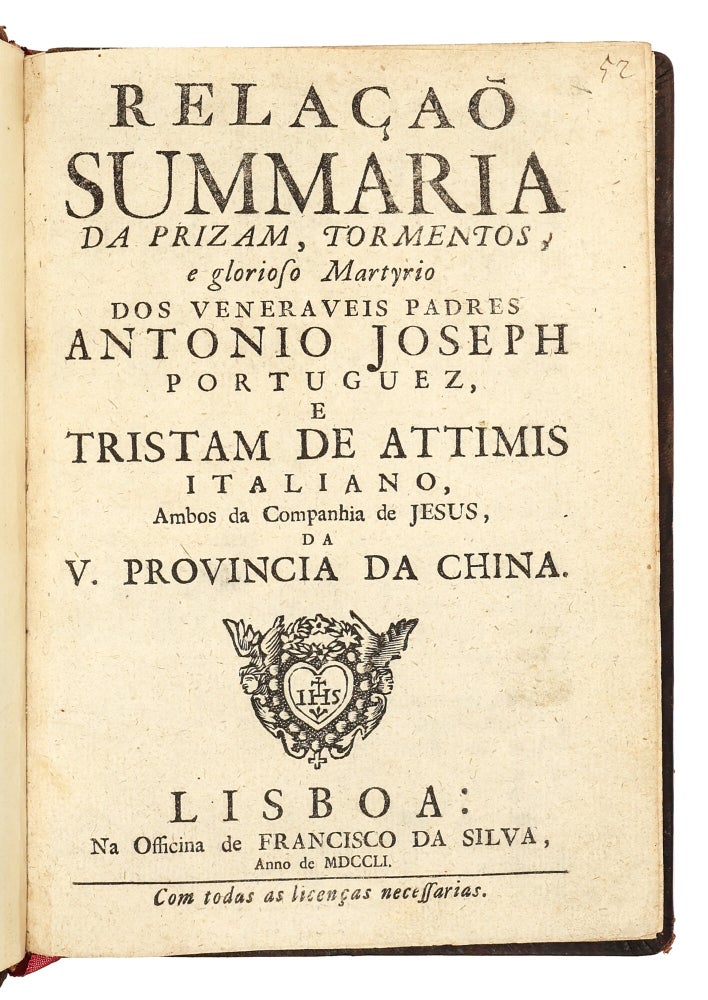


Relaçaõ Summaria da Prizam, Tormentos, e glorioso Martyrio dos Veneraveis Padres Antonio Joseph, Portuguez, e Tristam de Attimis, Italiano, Ambos da Companhia de Jesus, da V. Provincia da China.
Lisbon: Francisco da Silva, 1751.
Price: $8,500.00
Quarto: 18.7 x 13.6 cm. 38 pp. A-E4 (-E4 blank)
FIRST EDITION.
Bound in later sheep, boards ruled with gold filet, spine in compartments with gilt decoration and morocco title label (spine sunned, hinges and extremities rubbed, a second label with date loosely inserted). With the ex libris label of H. P. Kraus on the front paste-down. Title with woodcut Jesuit device, woodcut head- and tailpieces, decorated initial; pp. 5-6 with tiny amount of restoration (loss of a couple of letters), mild browning, a very good copy. Rare. Three copies traced in North America: Indiana, NYPL, and Minnesota.
Rare first edition of this substantial martyrological relation from China, issued shortly after the events it describes reached Europe, recounting the arrest, trial, and execution of two missionaries of the Jesuit Vice-Province of China, Antonio Joseph and Tristão de Attimis, Betrayed by a vindictive apostate, the two men were arrested in December 1747. They were put to death by garrote at Su-Cheu (Suzhou) on 13 September 1748. The book contains a description of the ordeal known as "image trampling", in which Christians were compelled to apostatize by stepping on Christian images (Christ, the Virgin Mary, etc.) or symbols (such as the Crucifix).
The anonymous author of this account was identified in the 18th c. as Luís de Sequeira, S.J., who served as rector for the Vice-province of China until his arrest at Macao in 1762 (He died at sea off the coast of Malabar in 1763). Sequeira relies on primary sources for his account, including two of the martyrs' prison letters and documents from the criminal tribunal. The account of the martyrdom itself, with a suspected poisoning attempt at the prisoners’ final meal, the failed use of wet paper to asphyxiate the two priests, and their eventual death by garrote, were taken from a report by one of the executioners.
In 1747, the Qianlong Emperor issued a decree ordering missionaries arrested and Christians punished throughout the empire; it was during this period of persecution that the two men were tried and executed. Sequeira traces the origin of the persecution of Christians to a private grievance in Fo-kien (Fujian), where a disaffected Christian's denunciation led to the execution of the Dominican bishop Pedro Sanz and four companions.
At various points during the trials of Antonio Joseph and Tristão de Attimis, Chinese officials tried, unsuccessfully, to intervene on the men’s behalf. At first two of the judges found the men guilty only of preaching a forbidden Law and sentenced them to four hundred blows, two months in the pillory, and expulsion. But this sentence was later revoked. During the trial some of the men’s Chinese servants and catechists were tortured but refused to testify against the Jesuits. Only one of the men broke under torture and accused the Jesuits of extracting unborn children from the womb to make gold in Europe, and of gouging out the eyes of the dead to make mirrors (which were then used as the eyes in European painted portraits, bringing them to life).
An instance of e-fumi in China:
The book includes a description of the ordeal of image trampling (in Japanese, e-fumi), a practice that originated in Japan and later spread to China and Vietnam. Before their execution, the Jesuits and their Chinese companions were commanded to step on images (called fumi-e) of Jesus and the Virgin Mary and to renounce their faith. Sequeira gives this full account:
“They ordered two Images thrown upon the ground, one of Christ, the other of His most Holy Mother, and commanded everyone to trample upon them. The Fathers prostrated themselves on the ground and adored them with the greatest reverence: the Mandarins pressed that the Fathers be the first to trample them, and, because Father Antonio Joseph was so afflicted in his feet, they ordered the constables to seize him and set him upon the Images. The constables went to seize the Father, but he, full of sacred fury, so sternly rebuked that violence that they did not dare force him to so execrable an outrage. Seeing Father Antonio Joseph's resistance, they did not press Father Tristão de Attimis, in whom they had no doubt they would find the same constancy. The abominable cruelty of the Mandarins did not stop here. They ordered Tam Joseph to trample the sacred Images. This valorous Catholic was so afflicted by the tortures he had undergone three times over that he could not stand, but on his knees drew near to the holy images, and, without fear or regard for the Mandarins, lifted them from the ground and kissed them, saying: ‘If you wish to cut off my head, I am ready, but that I should scorn the One I have always adored — this you shall never accomplish with me.’ The Mandarins grew furious, and, to satisfy their rage, had him beaten with many blows. Fourth came Pao Diogo, and, unmoved by the examples he had witnessed, he did not hesitate to step over the sacred Images; and, the Mandarins noticing that he had passed over them at a leap, made him repeat the act until he trampled them, at the same time renouncing the Faith of Christ. To this apostasy Vam Filippe followed, who, although faithful up to that time, upon seeing the danger of the bad example, was warned by Father Antonio Joseph, who said to him: ‘Filippe, if you fear God and value your soul, do not commit such wickedness, nor obey what they command you, for it is a most grave sacrilege.’ Encouraged by these words, this Christian took heart, as did many Christian women, whom they likewise ordered to commit the same irreverence; and, prostrate on the ground, weeping many tears, neither the violence nor the blows the constables gave them with leather whips could force them to trample the Images of Christ and of the most pure Virgin His Mother.”
Sequeira includes a report of prodigies that occurred while the men were in prison. On another occasion, under a clear sky, five black bands were seen crossing the heavens, and a Portuguese priest writing from Suzhou, reported to Sequeira that it had rained blood in that city. These prodigies, together with an epidemic that followed the executions, moved the viceroy to order propitiatory sacrifices at the martyrs' graves.
For a full discussion of the image trampling phenomenon, see Roux, "À l’école du Japon : le piétinement des images chrétiennes (ebumi) dans la Chine des Qing", Part 3.
De Backer - Sommervogel VII, 1132; Streit VII, 3406; Silva, Dic. bib. portuguez, 7:72, no. 169