

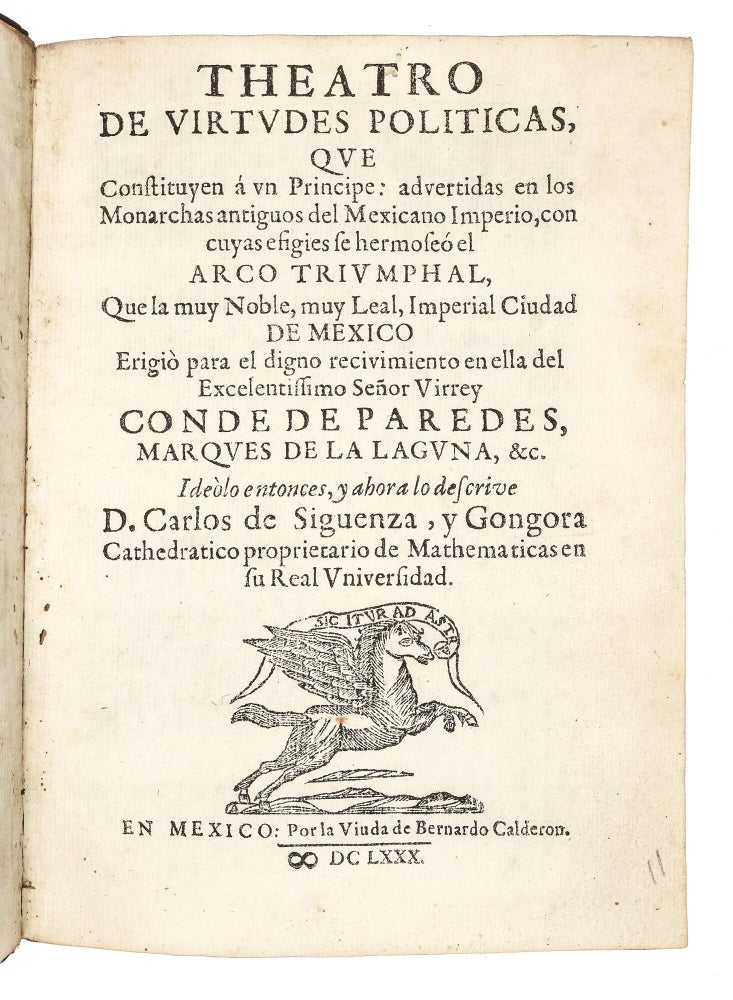


Theatro de virtudes politicas, que constituyen á un Principe: Advertidas en los monarchas antiguos del Mexicano Imperio, con cuyas efigies se hermoseó el Arco triumphal ...
Mexico: Por la viuda de Bernardo Calderon, 1680.
Price: $35,000.00
Quarto: 18.8 x 14.5 cm. [4] ff., 88 pp. Collation: [π]4, A-L4
FIRST EDITION.
Bound in 19th c. blind-ruled pebbled morocco, surface wear to the hinges (the boards still firmly attached). A very good, clean copy with some small, discreet repairs in the blank outer margin of a number of leaves, never affecting the text; a small worm-trail in the upper margin (not affecting the text), a few tiny wormholes in the inner margin of the opening leaves, and a few instances of light soiling. With the bookplate of Jacob P.R. Lyell [James Patrick Ronaldson Lyell (b. 1871)] Six copies traced in the U.S. (UT Austin, SMU, UT Rio Grande Valley, JCB, Princeton, and Dartmouth), with the copy at JCB lacking the epigraph leaf prior to the title-leaf.
The rare sole edition, written by the Mexican polymath Carlos de Sigüenza y Góngora, of this description of a celebratory arch, designed by Sigüenza and erected in Mexico City in November 1680. The occasion was the arrival of the new viceroy and vicereine, the Marquis Tomás Antonio de la Cerda, Conde de Paredes (later founder of New Mexico) and his wife Marquise María Luisa Manrique de Lara. Sor Juana Inés de la Cruz created a second arch for the occasion (about which, see below.)
“Polymath” is the term most often applied to Sigüenza y Góngora (1645–1700), a cosmographer, philosopher, chronicler, poet, biographer, historian, cartographer, and priest. Along with his friend and contemporary Sor Juana Inés de la Cruz, Sigüenza was considered one of the two principal figures of the Mexican Baroque, as well as the foremost authority on pre-Hispanic Mexican history.
The arch, as the title of his book makes explicit, was meant to instruct the new viceroy: “Theater of political Virtues that Constitute a Ruler, Observed in the Ancient Monarchs of the Mexican Empire, Whose Effigies Adorn the Arch Erected by the Very Noble imperial City of Mexico.” But it was also much more than that, for through his invention Sigüenza articulated a new vision of a distinctly Mexican culture, rooted as much in pre-Columbian Aztec culture as in that of Old World Spain.
No illustrations of the original arch exist; Sigüenza’s exhaustive description, detailing the monument’s dimensions and architectural elements, ornamentation (inscriptions, paintings, Aztec “glyphs”), its location, and even some details of the materials used in construction, is an unrivaled and invaluable record. It is also the key to interpreting the monument’s meaning.
“And if it was fortune that determined that at some point the Mexican monarchs were to emerge from the ashes of oblivion so that like phoenixes of the West they could be consecrated to immortal fame, then there was never a better time than the present since it is Your Excellency who will infuse them with spirit” -Sigüenza y Góngora
In anticipation of the arrival of the new viceroy and vicereine, two monumental arches were planned. The first, erected by the Cabildo of the city in the plaza of Santo Domingo, was designed by Sigüenza. The second, sponsored by the chapter of the Metropolitan Church and located opposite the western door of the Cathedral, was the work of Sor Juana Inés de la Cruz -and significantly, Sigüenza dedicates ten pages (his third “Preludio”), to addressing the imagery of Sor Juana’s arch. (See below)
“Sigüenza was entrusted with the arch at Santo Domingo and Sor Juana with the cathedral arch. Aside from the obvious honor and benefits, the commission offered each of them the opportunity to seek the favor of the new Viceroy. As writers of indeterminate status, they both needed that favor: she was a learned nun whose father no one knew; he was a professor of mathematics and astrology noted for his irritability and unpunctuality. Although today they are the outstanding figures of their century, to their contemporaries they were suspect: Sor Juana because of her origins, and Sigüenza because he had been expelled from the Jesuit order (for nocturnal escapades while a student in the Colegio del Espíritu Santo in Puebla). But in a government like that of New Spain-the Viceroy at the center, like a sun, and around him the courtiers, planets with no light of their own-the light of power could dispel any shadow or strain.”(Octavio Paz)
Unlike Sor Juana, who relied upon traditional European cultural iconography when designing her arch, Sigüenza chose a novel approach, drawing heavily from Aztec history and mythology for his project. By enriching a European architectural model (the triumphal arch) with indigenous Mexican imagery and symbolism (the Mexica gods and kings), without neglecting Catholic iconography, Sigüenza achieved a monument to a New Spain’s novel hybrid culture, a synthesis of Spanish, Criollo, and Indigenous identities.
“Sigüenza y Góngora’s ‘Teatro’ contributed to the creation of a Creole Mexican identity, which became manifest during the second half of the seventeenth century. In the ‘Teatro’, Sigüenza attempted to unify the dual ancestry of New Spain, Spanish and indigenous, by claiming a shared Aztec ancestry between the Native Mexicans and the Creoles…
“In his arch, Don Carlos eulogized the viceroy and also proclaimed New Spain’s cultural sophistication, the creativity and erudition of its artists, and the pride and self-assurance of the community that commissioned it. Traditionally the decorations of triumphal arches illustrated myths from Greek and Roman antiquity to publicize the virtues of the future ruler. Don Carlos designed a traditional structure based on European ephemeral architecture, but instead of using classical heroic themes as decorations, he chose the eleven Mexica rulers and the Mexica patron god, Huitzilopochtli, to illustrate the virtues of good government. Huitzilopochtli represented Faith; Acamapichtli, Hope; Huitzilihuitl, Clemency; Chimalpopoca, Sacrifice; Itzcoatl, Prudence; Moctezuma Ilhuicamina, Piety; Axayacatl, Fortitude; Tizoc, Peace; Ahuitzotl, Counsel; Moctezuma Xocoyotzin, Magnanimity; Cuitlahuac, Courage; and Cuauhtemoc, Constancy. The monument thus joined indigenous subject matter with Christian and classical themes.”(Fernández, “Vernacular Cosmopolitanism: Sigüenza y Góngora’s Teatro de Virtudes Políticas”)
Aztec “Hieroglyphics”:
“Mexica kingship provides not only the theme of the arch but also the basis for its iconography, which is drawn from the kings’ name glyphs. Sigüenza’s emblems, essentially, are a translation of pre-Columbian iconographic writing into European emblems. As no visual reproduction of the arch exists, this aspect of the arch must be understood from the description of the emblems themselves and from Sigüenza’s own declaration: “the impresse, or hieroglyphic, was deduced from the name of the emperor or the manner in which the Mexicans signified it in their paintings” (del nombre del Emperador, o del modo con que lo significavan los Mexicanos por sus pinturas se dedujo la Empressa, ó Hieroglyphico). Name glyphs were at once one of the clearest and most symbolic aspects of pre-Columbian iconographic writing, as they were often composed of elements signifying attributes of the person described. Indeed, in their combination of contradictory symbols unified through an anthropomorphic form, name glyphs were perhaps the closest analogy to Renaissance emblems. And yet, for Sigüenza’s contemporary Athanasius Kircher, Mexica glyphs also held an exotic and even occult meaning that allowed the Jesuit polymath to associate them with Egyptian hieroglyphs. By converting the name glyphs of Mexica emperors into emblems, then, Sigüenza reduces and concentrates these enigmatic qualities in a controlled iconography that accords with European visual language. After carefully detailing the twelve emblems that decorate the arch’s façade, each of which is a symbolic representation of a Mexica king based on his name glyph, Sigüenza links the symbolism of each king’s name to a historical anecdote from which he derives a moral lesson for leadership.
“The translation of the enigma of Mexica glyphs into a transcendental political foundation may be seen most clearly in one of the strangest anomalies of Sigüenza’s arch: only eleven of the twelve emblems are true Mexica monarchs. To the lineage of eleven pre-Columbian kings Sigüenza adds a surprising twelfth: not a monarch but Huitzilopochtli, the Mexica deity most demonized by the Spanish after the conquest. Although Sigüenza suggests that he includes Huitzilopochtli to give the arch numerological harmony, he also defends the importance of the deity as originator of the Mexica migration from Aztlan to Tenochtitlan:
‘This most beautiful machine of colors was animated, for the reasons that I have written in the second prelude, by the fiery spirit of the Mexica emperors, from Acamapich to Cuahtemoc, accompanied by Huitzilopochtli, not so much in order to complete the number of panels, but rather because he is justly deserving of praise for having led them from their patria, until now unknown, to these provinces, called in antiquity Anahuac.’
“Sigüenza’s defense of Huitzilopochtli’s historical role thus may itself be taken as a metaphor for the process of allegorization that the arch will effect, from an enigmatic and obscure origin to the clarity of historical time. This metaphor becomes clearer in Sigüenza’s description of the emblem based on the glyph of Huitzilopochtli’s name:
‘Amid clouds was painted a left arm gripping a fiery torch and accompanied by a leafy branch on which a hummingbird [Huitzilin] was perched, for which Virgil’s Aeneid provided the phrase: “God is my guide.” In the background, represented in the attire proper to the ancient Chichimecs [was] the valiant Huitzilopochtli, who, gesturing to the various people that which was seen in the clouds, exhorted them to migrate by proposing the destination and prize with the phrase from Genesis, chapter 43, “into a great nation.” It was my intention to make understood the need for princes to begin their actions with God, so that these might excel in greatness and be venerated as heroic.’
“The emblem is the centerpiece of Sigüenza’s argument that, rather than a god, Huitzilopochtli was a secular leader of the Mexica. Employing what Seznec argues is one of the oldest strategies for the secularization of pagan gods, euhemerism, Sigüenza goes on to argue that if the Mexica mistakenly thought that Huitzilopochtli was a deity, it was because “this action [was] so well considered in their ignorant barbarism that they did not know how to repay him except through apotheosis, and so after his death they venerated him as a god” (accion tan estimada de su barbaridad ignorante, que no supieron pagarla sino con la Apotheosis, conque despues de su muerte lo veneraron por Dios).”(More, Mexican Hieroglyphics: Creole Antiquarianism and the Politics of Empire, in Baroque Sovereignty, p. 125-127)
Sor Juana and Sigüenza:
The exact nature and extent of the relationship between Sor Juana and Sigüenza is poorly understood, as primary evidence is scarce. The very few times one of the authors does mention the other, or address each other's works, do little to enlighten us. The significance of Sigüenza’s funeral oration for Sor Juana, now lost, cannot be assessed, and the fact that Sigüenza owned manuscripts of some of her unpublished writings but would not allow them to be published posthumously, serves only to confuse. It is only in their parallel work on the arches in 1680 that we get a sense of something approximating a “working” relationship. The only time that Sor Juana mentions Sigüenza in her writing is in a sonnet written in association with the arches, and Sigüenza’s treatment of Sor Juana’s arch imagery is the longest of his extant estimations of her works.
As Octavio Paz wrote, “The friendship of Sor Juana and Sigüenza has been taken for granted, although a few skeptics have questioned it. Probably it was the sort of relationship that is usual among writers who live in a closed world; they saw one another frequently, read the same books, had similar intellectual interests, and were sometimes estranged by petty jealousies and resentments. In 1680 they were rivals… Sigüenza made clear in his ‘Teatro’ that his criticisms of other arches did not imply any censure of Sor Juana, whose work he respected. Sor Juana returned the compliment with a sonnet. It is the only time she mentions Sigüenza in her work and, significantly, the sonnet does not appear in the editions that were compiled during her lifetime.”(Paz, Sor Juana, p. 264)
In his Preludio III (pp. 11-20), Sigüenza takes great pains to assure his readers (and Sor Juana) that his critique of the use of pagan gods, rather than Mexican figures, in Novohispanic arches does not extend to Sor Juana’s Neptune. He does this by cleverly explaining that Neptune, “Is Not the Imaginary God of the Pagans but the Son of Mizraim, Grandson of Ham, Great-grandson of Noah, and Father of the Indians of the West.” He does not criticize her arch, much less does he “dare to desecrate the sublimity of the erudition that adorns it.”
Moreover, he offers fulsome praise of Sor Juana, the encyclopedism of her learning and the universality of her lyrics. In Sor Juana, Mexico enjoys in a single person what in previous centuries the Graces had apportioned among numerous learned women, who in history books were objects of veneration and amazement. There is “no pen that can rise to the towering eminence where hers excels.”
"Cuanto en el antecedente preludio se ha discurrido, mas tiene por objeto dar razón de lo que dispuse en el arco que perjudicar lo que en él que erigió la santa lglesia Metropolitana de México, el mismo intento ideo la madre Juana Inés de la Cruz, religiosa del convento de San Jerónimo de esta ciudad, y dicho se estaba, cuando no hay pluma que pueda elevarse a la eminencia donde la suya descuella, cuanto, y mas atreverse a profanar la sublimidad de la erudición que la adorna. Prescindir quisiera el aprecio con que la miro, de la veneración que con sus obras granjea, para manifestar al mundo cuanto es lo que atesora su capacidad en la enciclopedia y universalidad de sus letras, para que se supiera el que en un solo individuo goza México lo que en los siglos anteriores repartieron las Gracias a cuantas doctas mujeres son el asombro venerable de las historias ...
“Dije no le perjudicaba lo que yo he escrito porque no dudo el que prevendria al elegir el asunto con que habia de aplaudir a nuestro excelentisimo principe, no ser Neptuno quimérico rey, o fabulosa deidad, sino sujeto que con realidad subsistió, con circunstancias tan primorosas, como son haber sido el progenitor de los indios americanos."(p. 11 ff.).
Medina, Mexico, 1216; Andrade 734; Tovar de Teresa, Bibliografia novohispana de arte, 72