

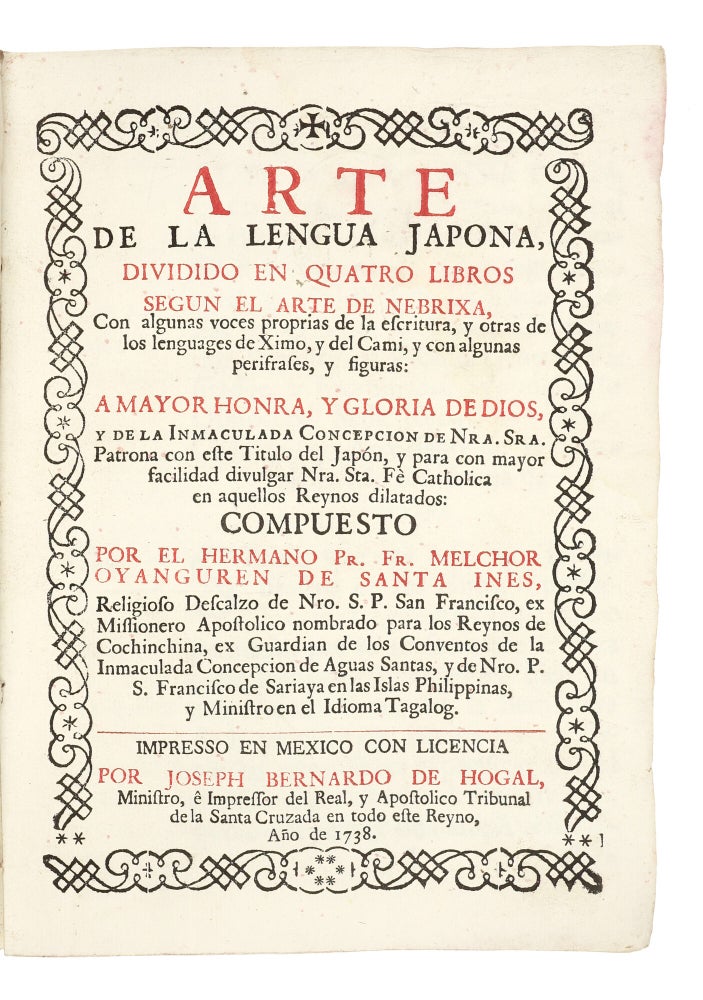


Arte de la lengua japona, dividido en quatro libros según el arte de Nebrixa, con algunas voces proprias de la escritura, y otras de los lenguages de Ximo, y del Cami, y con algunas perifrases, y figuras
Mexico: Joseph Bernardo de Hogal, 1738.
Price: $28,000.00
Quarto: 20 x 14.5 cm. [20], 200, [2] pp.
FIRST EDITION.
Bound in contemporary vellum. Manuscript annotation at front endpaper “Este libro va para D. Sebastian de Arauna beneficiado, y cura en la Villa de Helorrio en el Señorio de Vizcaya”.
An extremely rare Japanese grammar, printed in Mexico for the use of Franciscan missionaries to Japan. It also includes a number of sections devoted to the teaching of Chinese. In the course of the book, the author “often compares several Asian languages -Japanese, Tagalog, Chinese, and occasionally Malay; Arabic, the language of Siam, and one Amerindian language, Nahuatl, with European vernaculars like Castilian, Basque, Italian, etc. and classical languages, such as Greek, Latin and Hebrew.
“The cross-linguistic comparisons of Oyanguren are unique for the period in question, not only in quantity but also in quality. Particularly his attempts to describe coincidences between two unrelated agglutinative languages, Basque and Japanese, and a language which has prefixes and suffixes like Tagalog, contrasting them with the typological features of an isolating language, Chinese, are to be considered an important contribution in the history of linguistics.
“The Basque Franciscan missionary Melchor Oyanguren de Santa Inés was born in Salinas (Guipúzcoa) in 1688. He set out for the Philippines in 1715, arriving there in 1717. He was sent to the missions in Cochinchina (southern Vietnam), where he was imprisoned and subsequently banished to Manila; there, he fell ill. In 1721, he returned to Mexico to recover from his illness and went back to the Philippines in 1725. A year later, he was appointed missionary priest for the town of Baños de Aguas Santas and served in Saryaya until 1736. Due to his frail health, he had to return to Spain, but upon reaching Mexico, he was unable to continue his journey. In 1744, he assumed the position of superior of the hospice at the San Agustín de las Cuevas convent in Tlalpan—located in present-day Mexico City—where he died in 1747…. While in Mexico he published this grammar of Japanese (1738) and another of Tagalog (1742).
“Oyanguren’s Japanese grammar… is valuable for analyzing how a non-Indo-European language like Japanese was described in the 18th century—in comparison with other non-Indo-European languages such as Basque, Tagalog, and Chinese.
“His linguistic data of Japanese are mainly derived from the anonymous ‘Vocabulario de Japón declarado primero en Portugués,’ printed in 1630 in Manila (Colegio de Santo Tomás) by the printers Tomás Pinpín and Iacinto Magauriva, and attributed to Iacinto Esquivel — a Spanish translation of the ‘Vocabulario da Lingoa de Iapam com a declaração em Portugues’ completed in 1604 in Nagasaki… The most important grammatical sources for [Oyanguren’s] Japanese ‘Arte’ were the Latin grammar of Antonio de Nebrija (c. 1444-1522) and the grammar of Japanese written by the Spaniard Diego Collado (d. 1638) - who had been inspired mainly by the works of Nebrija and João Rodrigues (1561-1634). The title of Oyanguren’s book states that he included ‘some terms from the Ximo and Cami languages’ and in this regard, he faithfully follows the ‘Vocabulario’.
Oyanguren was self-taught in Japanese, relying on printed sources without the involvement of native speakers. He described Japanese essentially according to the Latin model of eight parts of speech. The final section is dedicated to rhetorical figures.
“The languages the Franciscan grew up speaking were Basque and Spanish. As the titles of the grammars suggest, he had learned Latin, Greek, Hebrew, and Chinese; furthermore, we know he possessed some knowledge of Vietnamese and Malay.
It is possible that Oyanguren was familiar with certain Mesoamerican grammars, although he compared Tagalog with Nahuatl on only one occasion.
“The Japanese grammar was published by Joseph Bernardo de Hogal, who was—as the title page states—"Minister and Printer to the Royal and Apostolic Tribunal of the Holy Crusade throughout this Kingdom." Hogal was born in Spain and established his printing house in 1721. His workshop was capable of printing with special typefaces, such as Greek and musical notation.
“Oyanguren enriched his grammar with word lists arranged either thematically—as seen in the final chapter regarding ‘integral parts of the body’—or alphabetically, as in the list of writing-related terms. He does not entirely break with his predecessors, however, as lists of verbs organized by morphological criteria are also included. At times, Oyanguren presents the reader with original schemes or paradigms that do not appear in this form in any of his predecessors' works. In his chapter on declensions, Oyanguren presents the reader with complete noun paradigms—including cases, numbers, and the four levels of social stratification.
“[As] we have demonstrated elsewhere (Zwartjes 2008), Oyanguren did not always intend to write a purely ‘pedagogical’ work in the strict sense of one designed for ‘learning Japanese.’ He composed a work that goes ‘beyond practical pedagogy,’ as it contains numerous sections focused more on general education. His countless references to so many different languages likely held little pedagogical value for those unfamiliar with them, or for those who simply wished to learn a language without needing to delve into comparative linguistics. References to Basque could offer no practical pedagogical value to non-Basque speakers, and the comparisons do not appear to have been intended exclusively for those who merely wished to learn Japanese.” Klöter and Zwartjes, Chinese in the Grammars of Tagalog and Japanese of the Franciscan Melchor Oyanguren de Santa Inés, in Histoire Épistémologie Langage 30(2), p. 177 ff.).
Medina Mexico, 3513; Palau 207852; Sabin 58044; Viñaza “Lengua China y el Japon” 236; Graesse vol. 5 pp. 99; Beristain, Vol. II., p. 378; Maggs “Bibliotheca Asiatica Part I. Catalogue 452, nº507