



Discorso Sopra Il Principio Di Tvtti I Canti D'Orlando Fvrioso
Venice: Appresso Gabriel Giolito De'Ferrari, 1559.
Price: $3,800.00
Octavo: 14.6 x 10 cm. [176] pp. Collation: A-L8
FIFTH EDITION (first ed. 1549), published by Giolito, who also published the first edition.
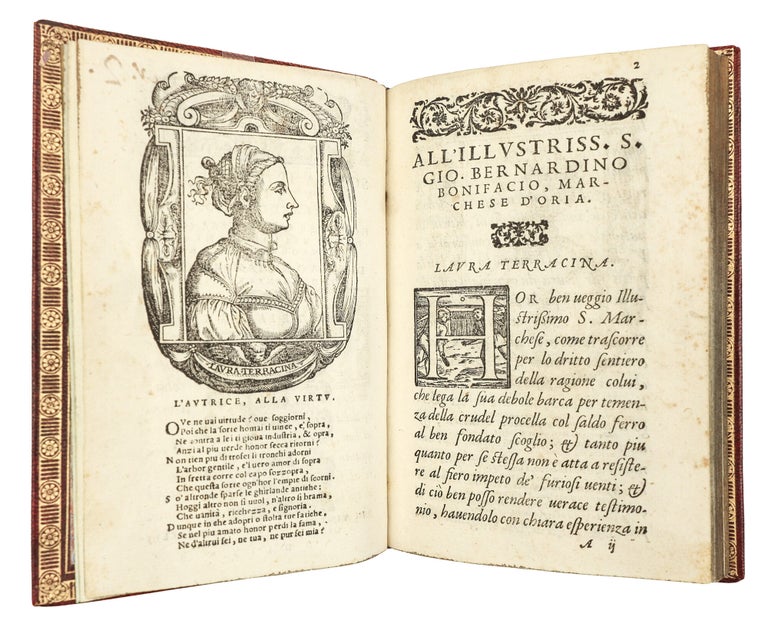
Bound in late 20th c. morocco, gilt. With an attractive woodcut headpiece and the Giolito device on the title page. The fine portrait of Laura Terracina, set within an ornate frame, appears on the verso of the same leaf. With woodcut initials and 46 woodcut scenes taken from the 1542 Giolito edition of Ariosto's poem. Text lightly foxed, more heavily in the first gathering, occasional light stains (including a light oil stain on the 3rd leaf), text trimmed close at the upper edge, shaving some headlines.
“Laura Terracina achieved remarkable success as a poet during her own lifetime, only to be vituperated and then neglected after her death. She was born sometime around 1519 into a noble Neapolitan family loyal to the Spanish monarchy. Her parents were Paolo Bacio Terracina and Diana Onofra, and the family lived in Chiaia, on the coast near Naples. She seems to have had a number of romantic attachments, but her eventual marriage to a relative, Polidoro Terracina, at close to forty years of age, appears not to have been a happy one, to judge from her subsequent poems. Terracina is believed to have died sometime after 1577. For a long time she was thought to have been married to the poet Giovanni Mauro, but this has since been shown to be false and based only on Traiano Boccalini's satirical treatment of her in his Ragguagli di Parnaso (1612).
“During her lifetime she was made famous by her Petrarchan poetry, much of it encomiastic. Her works from the 1550s onward are also marked by an awareness of her role as a specifically female writer. The collections of poetry she published were enormously popular. Despite the fact that she was educated at home, she became a member of the Accademia degli Incogniti (1545-1547) under the pseudonym ‘Febea’ and corresponded with many of the poets of her age.”(Italian Women Writers Project, University of Chicago)
“By far the most-published female-authored work of the period (1540-1560) outside the field of lyric poetry (or indeed, within it), was Laura Terracina’s ‘Discorso’ on the proemi of Ariosto’s ‘Orlando Furioso’, which carried her signature genre of the trasmutazione into a more structured and larger-scale work. The ‘Discorso’ is made up of a series of trazmutazioni on the forty-six initial stanze of successive canti of the ‘Orlando Furioso’, making up a series of miniature seven-stanza canti, each with its own one-stanza incipit addressed to a separate individual or collective dedicatee. Terracina used this ingenious form as a vehicle for a sort of highly original and sui generis lay ministry, developing moral and political themes mainly, but not always, deriving from the Ariostan proemi on which they draw. The task is well suited to her trenchant and unnuanced voice; this is certainly her most successful work artistically, as well as in terms of popular appeal.”(Virginia Cox, Women’s Writing in Italy, 1400-1650, p. 112-113).
Bongi, II, 77-78; BM Italian 665; CNCE 54883. See Agnelli-Ravegnani pp. 202-204