

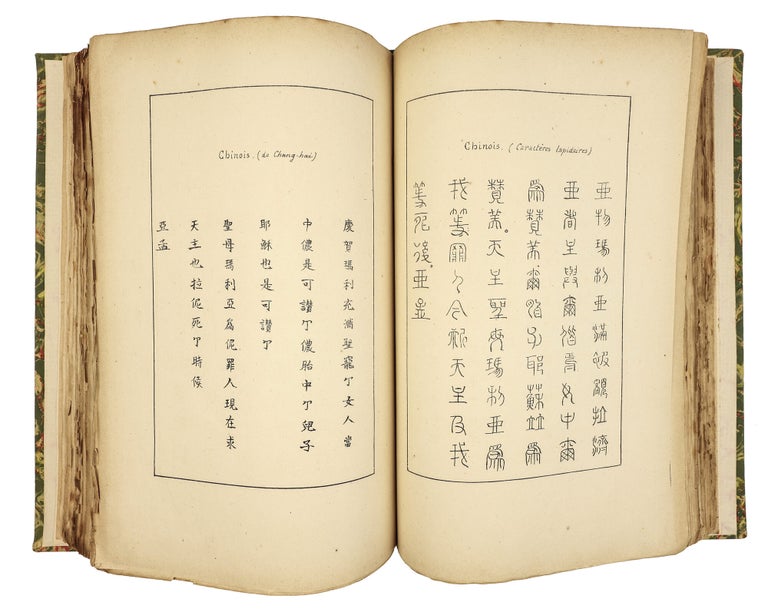


Ave Maria, sive Maria ab Angelo variis linguis salutata, cui omnia a se collecta scriptaque D D D, P. A. Pfister, S.J.
Chang-hai [Shanghai]: Mission catholique de Tou-cé-wei, 1882.
Price: $15,000.00
Quarto: 26 x 18 cm. 1 leaf (title), [340], 15 (index) pp.
SOLE EDITION.
Bound in recent quarter morocco over marbled papered boards, spine with raised bands and contrasting title label lettered in gilt. Extremely rare. I have located only 1 copy (at Villanova) in North America.
Lithographically printed on leaves folded in the traditional Chinese manner; partly unopened; both the title-leaf and the final leaf of the index have been re-margined, with some restoration at corners, otherwise sound and clean throughout. The book was published by the Mission catholique de Tou-cé-wei, a prominent French Jesuit Catholic mission, orphanage, and vocational art school founded in 1864 in the Xujiahui (Zi-ka-wei) district of Shanghai. Cordier (despite his close friendship with Pfister) was not aware of this work. It does not appear in Bibliotheca Sinica or in the list of Pfister’s works at the end of Cordier’s “In Memoriam”.
The rare sole edition of this unusual work published by the Catholic Mission in Shanghai. It comprises lithographic printings of the Ave Maria (Hail Mary) prayer in 340 different languages and dialects, employing the original script, written out by the author in every instance, for each particular language, such as for Geʽez, Badlit (Bisaya), Japanese, Chinese, Vietnamese, Tibetan, Korean, Russian, Celtic, Arabic, Persian, Sinhala (Sri Lankan), etc. Chippewa (Southwestern Ojibwe) is written in the syllabary created in 1840 by James Evans of the Wesleyan Missionary Society.
A large number of the languages represented in the work are those of the indigenous peoples of the Americas, Asia, Africa, and Australia. Some examples of the languages of the Americas, spoken by peoples from Canada to the Caribbean to South America, include Huron, Iroquois, Chinuk Wawa, Beaver, Gwichʼin (under the outdated, offensive name Loucheux), Nimíipuu, Potawatomi (Neshnabémwen), Martinique Creole, Quechua, Guaraní, and Aymara; Those from Asia are the most numerous, and include Malay, Bisaya (Cebuano), Pampango, Cantonese (and an array of Chinese dialects), Karen (spoken in Myanmar), Malagasy, Bisaya, Tagalog, Korean, and Japanese (shown in a variety of scripts); from Africa we have Tswana, Shilluk (Dhog Collo), Kabyle (Taqbaylit), Zulu, Geʽez, Arabic, and Wolof. There is a prayer in an Australian Aboriginal language which, although generically described as ‘Australien‘, is the Kaurna Warra (language) spoken by the Kaurna Miyurna (people), who are the Yaitya mathanya (traditional owners/custodians) of Wama Tarntanya (the Adelaide Plains).
The book was compiled by the French Jesuit missionary, linguist, historian and sinologist Fr. Aloys (Louis) Pfister (1833-1891), also known by his Chinese name Fei Laizhi (Chinese: 費賴之 / 费赖之), who served as librarian at the Catholic Bibliotheca Zikawei (now the Xujiahui Library), established in 1847 by the Jesuits five miles from Shanghai. Pfister had joined the Society of Jesus in 1852 and arrived in Kiang-nan in 1867. In addition to his duties as librarian, he ministered to people -in their language- in remote Chinese villages. Coronary disease forced him to retire to Shanghai in 1889, where he died, in the Yang-king-pang residence, in 1891.
Pfister’s project was an extraordinary undertaking, and its publication a remarkable achievement, one that was made possible by position at the Zikawei library, which he reorganized and expanded, where he could receive and organize correspondence and books from his fellow Catholic missionary-linguists in other parts of the world.
At the end of the book, Pfister provides a remarkable index of the sources, both printed and manuscript, from which he drew his information, much of it sent directly to him in China. For the Abenaki entry, Pfister writes that he relied on a version produced by a native Abenaki, sent to him in a letter by James Perron (1818–1890), former Superior of the Canadian Mission, from Woodstock College in Maryland, “Abénaqui, écrit par Job Laurent, abénaqui de nation, et envoyé de Woodstock, 1881, par le R.P. Perron.” In the same parcel, Perron sent an example in Huron, written by another native speaker, “Jos. Hodilon, Huron de nation.” The entry for Algonquin was also provided by Perron, this time in an -unnamed- printed book, “envoyé de Woodstock, 1881”, with the aforementioned letter. This parcel from Woodstock included additional printed texts and manuscripts.
The translation of the Ave Maria from Latin into Kaurna Warra was made by the German Jesuit missionary and naturalist Johann Nepomuk Hinteröcker (1820-1872), who arrived in South Australia in 1866 and settled at Sevenhill in the Clare Valley. It would appear that the translation is based on the grammar and vocabulary of Lutheran missionaries Teichelmann and Schürmann, which had been published as early as 1840, as the spellings in the translation, with occasional small divergences, are largely consistent with those used in their work.
Pfister lays out his plan for this work:
In his notice (avis) to the reader, Pfister explains that this is a preliminary work for a larger project. That project would never come to fruition, making Pfister’s “Avis” the only source for our knowledge of his vision. It reads in full:
With the approval of Holy Church and under her guidance, the piety of the faithful has neglected nothing in order to glorify the Blessed and ever-Virgin Mary, Mother of God: altars, sanctuaries, and basilicas have been consecrated to her cult and have become the gathering-point of countless throngs of pilgrims; books have been written in her honor, poems of every kind and in every language, to proclaim her praises, exalt her power, and celebrate her goodness; congregations have been founded under her protection for every class of society, religious orders, hospitals and houses of refuge, colleges for every need of body and soul; feasts and processions have been held to implore her aid and to thank her for her benefits; images, statues, paintings — it would seem that nothing has been left undone.
But where Mary is concerned, nunquam satis — "never enough." Meditating on these words of the Blessed Virgin, "Beatam me dicent omnes generationes" ("all generations shall call me blessed"), I came to believe that something more could still be done — that Linguistics, Calligraphy, and Typography, too, in their own way, could still contribute to glorifying the Queen of the universe, the Mother of divine Wisdom. All nations will proclaim me blessed; and how? Doubtless by repeating the Archangel Gabriel's greeting: Ave Maria.
In publishing this prayer — so simple and yet so profound, brought down from Heaven to earth — in every language of the world, may I not hope that it will not be in vain, this small stone that I bring to the majestic edifice raised up over the centuries in honor of our Mother?
I harbor no illusions, however. This undertaking is beyond my powers, and I do not presume to carry it through to completion; I content myself with commending it to the zeal and devotion of all toward the most holy Mother of God, and with laying down a few markers along the way. Little by little others will add to it, and in a few years perhaps a complete work may be offered to the Catholic world.
Subject to better judgment, here is how I would conceive of this publication:
First. The Ave Maria in every language, every idiom, every dialect of the entire world, with the particular characters proper to each — all languages classified by race and by family... Dead languages would not be forgotten either — not only Hebrew, Greek, and Latin, but also Samaritan, Phoenician, Assyrian, Median (with cuneiform characters), Egyptian (hieroglyphics), Zend, Pali, Kawi... Etruscan, Oscan, Gothic, Teutonic, Norse (with runic characters), Mexican [Nahuatl]... etc.
For Latin, for example, as for the others, [it would include] the characters in use in the various countries, in every era, from the Christian era down to our own day.
For living languages, the same would be done with the orthography, the modifications and changes these languages have undergone as they developed from their origin to the present, not only over the course of the years but also across their various regions and provinces. This would encompass every idiom, dialect, and patois, whether extinct or still in use.
Second. The printing would be done using the most beautiful, most elegant, and most varied type, except in cases of imitation of old books or manuscripts [presumably here Pfister envisions using engravings or lithographs].
Third. Each Ave Maria would be adorned with large historiated or painted capital letters, with borders in black and in chromolithography, depicting vignettes, ornaments, and scenes relating to the usages, manners, and customs... of the countries in which the language is spoken. In this way one would have a fine illustrated work, and it would also be possible to produce an edition without ornamentation.
By calling on the cooperation of missionaries, scholars, and artists of every kind, rich and poor alike, the thing does not seem impossible.
Moreover, one can well understand what the usefulness of such a collection would be for linguistics, comparative philology, the study of writing systems, etc.
I offer, to begin, these 340 hand-lettered Ave Maria. As all are in my own hand, any errors that may be found in them are attributable to me. I was not able to arrange them in the desirable order, because I received a good number of them after their counterparts [in other languages/scripts] had already been written; but I deliberately omitted pagination, so as to leave each person free to arrange them as he pleases. At the end, in the alphabetical index, I indicate the provenance of each one.
As is only fitting, I submit the whole to the judgment of our Holy Mother the Church.
Shanghai, China. 8 December 1881.
A.X. Pfister, S.J.
Sommervogel VI, p. 657 col. 1; Not in Cordier, Sinica. For Pfister’s life, see Cordier’s “Aloys Pfister” in T’oung Pao, Vol. 2, No. 5, 1891.