

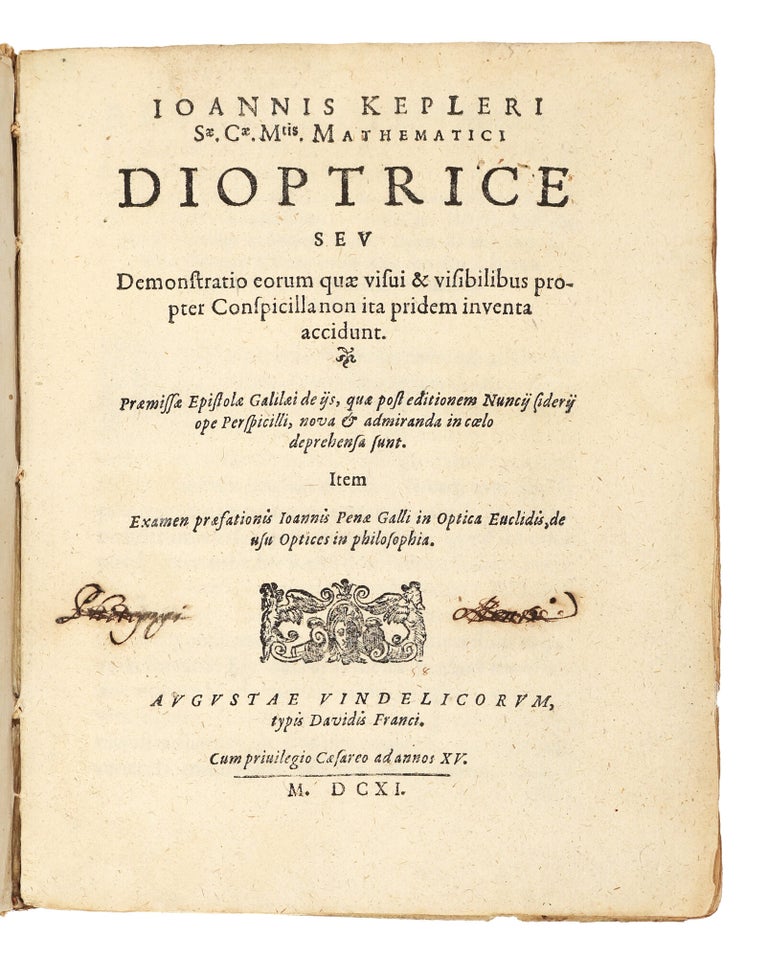


Dioptrice seu demonstratio eorum quae visui & visibilibus propter conspicilla non ita pridem inventa accidunt. Praemissae epistolae Galilaei de iis, quae post editionem Nuncii Siderii ope perspicilli, nova & admiranda in coelo deprehensa sunt. Item Examen praefationis Joannis Penae Galli in Optica Euclidis, de usu optices in philosophia.
Augsburg: typis Davidis Franci, 1611.
Price: $80,000.00
Quarto: 19.7 x 16 cm. [8], 1-26, [2], 27-80, [2] p. Collation: )(4, a-c4, d2, A-K4, π1 (meant to be inserted between lvs. D1 and D2), chi1. Complete
FIRST EDITION.
Bound in contemporary limp vellum (re-cased, with discreet repairs, quires re-sewn onto the original sewing supports), manuscript title to spine. A very good copy, with a number of slim worm-trails discreetly filled, some occasionally entering the text, with instances of -very deft- restoration of a few letters or the occasional word on various leaves. Ink splatter on pp. 7–8; gathering ‘c’ slightly browned; tiny ink spot on leaf A4 and B1; light foxing to lower margin of gathering C; lvs. E3-4 with short, slim worm-trail in text, F2-3 with small ink spots; bottom margin of pp. 43–44 folded in (to avoid trimming the illustration); a few tiny wormholes in the text; early signature, scored through and illegible, on the title page. Complete with the errata leaf and the leaf added after p. 26 referring to ‘propositio’ LXIV.
First edition of the foundation work that “changed the course of optics”(DSB), containing both the first accurate theory of lenses and the formation of images by the eye. The book is a direct result of the recently published “Sidereus Nuncius” (1610), in which Galileo announced his observations made with the telescope, among them that the Moon, thought to be smooth, was in fact mountainous and craggy; and that Jupiter had moons of its own.
“In order that the enormous possibilities harbored in [the telescope] could develop it was necessary to clear up the theoretical laws by which it worked. And this achievement was reserved solely for Kepler. With the energy peculiar to him, inside of a few weeks, in the months of August and September of 1610, he composed a book tracing basically once and for all the laws governing the passage of light through lenses and systems of lenses.”(Caspar) The book also contains Kepler’s description of his own modified version of the telescope, known to us as the “astronomical” or “Keplerian” telescope.
In his preface, Kepler discusses the further discoveries that Galileo had made with his telescope subsequent to the publication of his “Sidereus Nuncius”, and includes four letters by Galileo, dated 13 October 1610, 11 December 1610, 1 January 1611, and 26 March 1611, which he sent to Kepler via the Medici ambassador at Prague. These new Galilean discoveries include his observations that Saturn is not a single orb, but rather three orbs close together (the telescope was too weak to clearly reveal the planet’s rings); and that Venus has phases and reflects the Sun’s light (rather than generating its own), which evidence proves that Venus orbits the Sun.
“[Kepler’s ‘Dioptrice’] is divided into 141 theorems which are distinguished as definitions, axioms (theorems needing no proof), problems (theorems to be proved by experiments), and propositions (theorems which follow out of definitions and axioms by logical conclusions).
“The author begins with the law of refraction which, indeed, he was here as little able to express exactly as in his earlier work about optics. Since in the ‘Dioptrice’ however, only small angles of incidence are dealt with, he managed well by assuming the proportionality between the angle of incidence and that of refraction. He himself determined the ratio by measurements. By investigating the path of a ray in a glass cube and three-sided prism he discovered total reflection.
“Next in his exposition comes the treatment of the double-convex converging lens. He sets to work with great thoroughness. There appear the ideas well known to us of the real and virtual, the upright and inverted image, the distance of the image and the object, the magnification or reduction of the image. From the path of the ray for a simple lens he proceeds to two- and three-lens systems. In problem eighty-six in which he shows ‘how with the help of two convex lenses visible objects can be made larger and distinct but inverted’ he develops the principle on which the so-called astronomical telescope is based, the discovery of which is thus tied up with his name for all time.
“Further on follows the research into the double concave diverging lens and the Galilean telescope in which a converging [convex] lens is used as objective and a diverging [double concave] lens as eyepiece. By the suitable combination of a converging lens with a diverging lens in place of a simple object lens he discovers the principle of today's so-called telescopic lens by which an inverted real image of an object can be produced, an image which is in fact larger than that formed by a converging lens alone. Even this scanty account of the main content shows the epoch-making significance of the work. It is not an overstatement to call Kepler the father of modern optics because of it.”(Caspar, Kepler, p. 198–199)
The Keplerian vs. Galilean telescope:
Whereas the Galilean telescope consisted of a convex convergent lens as the objective (the lens that forms the image) and a double-concave divergent lens for the eyepiece, the telescope proposed by Kepler used two convex lenses. Although Kepler’s version produced an inverted image, it had a larger field of view and higher magnification than the Galilean version.
“In any telescope system the objective (which gathers light to form the image) — even when made up of several elements, both converging and diverging — must always be converging as a whole. The Galilean and the Keplerian telescopes thus differ only in the eyepiece, which is diverging in the former, converging in the latter.
“The Galilean telescope consists of a converging lens (plano-convex or biconvex) serving as objective, and a diverging lens (plano-concave or biconcave) serving as eyepiece. The eyepiece is situated in front of the focal point of the objective, at a distance from the focal point equal to the focal length of the eyepiece. Since converging lenses are conventionally positive (or of positive optical power) and diverging ones negative (or of negative optical power), we can also say that the distance between the objective and the eyepiece is equal to the algebraic sum of their focal lengths. The negative eyepiece intercepts the converging rays coming from the objective, rendering them parallel and thus forming, to the infinite (afocal position), a virtual image, magnified and erect. The magnification of the system is determined by the ratio between the focal length of the objective and that of the eyepiece. The Galilean telescope, although it furnishes erect images with the aid of erector devices, has the severe drawback of an extremely narrow field of view (which makes it, in practice, usable only for magnifications up to around thirty).
“The principle of operation of the Keplerian telescope is relatively simple. The objective forms a real image, diminished in size and upside-down, of the object observed. The eyepiece — which, consisting of a converging lens with short focal length, is actually a magnifying lens — enlarges the image formed by the objective. The image observed is however upside-down, so that the Keplerian telescope, at least for terrestrial use, must be fitted with some kind of erector device which, by inverting the image again, erects it. But this disadvantage is amply compensated for by a much greater and more evenly illuminated field of view than that of the Galilean telescopes.”(Museo Galileo, Florence).
Caspar, Bibliographia Kepleriana, 40. Cinti, Biblioteca Galileiana, 31. Carli Favaro, Bibliografia galileiana (1568-1895) 42. DiLaura, Bibliotheca Opticoria, 56. King, The History of the Telescope, p. 44–45. Honeyman V, 1788