



Historia del glorioso martirio di sedici sacerdoti martirizati in Inghilterra per la confessione, & difesa della fede catolica, l'anno 1581, 1582, & 1583 : con vna prefatione, che dichiara la loro innocenza; Con vna prefatione, che dichiara la loro innocenza; composta da quelli, che co essi praticauanomen tre erano viui, & si trouorno presenti al lor giuditio, & morte. Tradotta di lingua inglese in italiana da vno del Collegio inglese di Roma. S'è aggiunto il martirio di due altre sacerdoti, & vno secolare inglesi, martirizati l'anno 1577. & 1578.
Macerata: Appresso Sebastiano Martellini, con licenza de' superiori, 1583.
Price: $9,500.00
Octavo: 15.5 x 10 cm. 210, [6] p. A-N8, O4. With six leaves of engravings.
FIRST ITALIAN EDITION, the second edition overall, and the FIRST ILLUSTRATED EDITION.
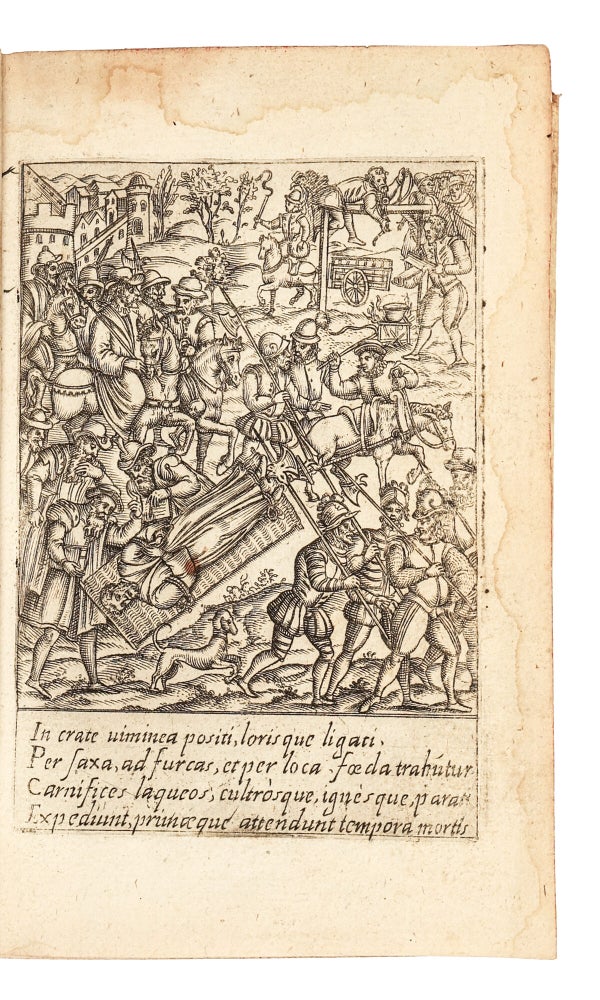
Bound in 19th c. ivory vellum (hinges repaired at head and foot, light soiling, spine label fragmentary), the boards ruled in gold, the spine gold-tooled with repeating floral tools. Illustrated with six engraved plates of Catholic priests being abused, apprehended, tortured and executed (described in detail, below.) With a woodcut title vignette of the Crucifixion, a woodcut of the Pietà on leaf D7 verso, printer’s ornaments and woodcut initials. The text is type-ruled throughout. The text is in very good condition aside from damp-staining in gathering B and the six plates; the title page is soiled and has a small area of restoration at the upper corner as well as a clean tear (mended) and a little staining in the gutter. There is a light oil stain on leaf H6 and a marginal paper flaw on leaf N5.
A translation, with additional material, of Allen’s "A briefe historie of the glorious martyrdom of XII. reuerend priests, executed vvithin these tvveluemonethes for confession and defence of the Catholike faith." (Rheims: J. Foigny?, 1582). The English edition exists in only 2 copies (British Library and Westminster Cathedral Library.) This edition, the first edition to include the six engraved illustrations, is also rare. OCLC locates copies of the Macerata edition at 7 institutions in North America. (see notes below for holdings.)
The central figure of Allen’s martyrology is the Jesuit Edmund Campion (1540-1581) who, at Allen’s request and along with Robert Parsons, led the first Mission to England. Campion and his companions were arrested on 17 July 1581. The present work recounts the arrest, trial and eventual execution of Campion, as well as the priests Ralph Sherwin, Alexander Briant, Thomas Ford, John Shert, Robert Johnson, William Filby, Luke Kirby, Lawrence Richardson, John Payne, and Everard Hanse; as well as the Jesuit Thomas Cottam.
Included in these accounts are the transcripts of Campion’s final letter to the Jesuit General Claudio Aquaviva, Ralph Sherwin’s letter from the Tower, and Alexander Briant’s letter written while imprisoned to the Jesuit fathers in England requesting admission to the Society, which was granted.
Allen, who continued to receive material up to the time of publication, appended the martyrdoms of Cuthbert Maine, John Nelson and Thomas Sherwood (all of whom died in 1577 and 1578) to his account of the martyrs of 1581 and 1582. The translator of the present edition added an additional account, not found in the English edition, of the martyrdom of 4 English priests in 1583.
The Engravings:
The six engravings in this work first appeared in the first edition of Robert Parson’s "De Persecutione Anglicana Libellus", published by the Jesuit College at Rome in 1582. Each of the six images is accompanied by a four-line explanation in hexameter verse.
"The first plate depicts priests being apprehended in private houses and marched off to prison; the second, in amplification, shows various priests, some still in their vestments, being led away either on horseback or on foot, but always securely bound, two gentlewomen who had sheltered them being led to the same destination. In the third a priest is being scourged while tied to the back of a cart, and below, in the foreground, an examination is in progress as preparations are made for torture. The fourth picture illustrates a racking, with three other victims lined up to await their turn. In the fifth the priests are being dragged to execution on hurdles while the instruments of death are prepared; and the final plate represents the different stages of martyrdom, from the hanging to the drawing, quartering and burning of entrails."(Anthony G. Petti in Recusant History, April 1966, pp. 288-91)
Edmund Campion:
"Campion was arrested with his companions on 17 July, 1581. Amid scenes of violent excitement, Campion was derisively paraded through the streets of his native city, bound hand and foot, riding backwards, with a paper stuck in his hat to denote the 'seditious Jesuit'. First thrown into Little Ease at the Tower, he was carried privately to the house of his old patron, the Earl of Leicester; there he encountered the queen herself, and received earnest proffers of liberty and preferments would he but forsake his papistry. Hopton having tried in vain the same blandishments, on Campion's return to the Tower, the priest was then examined under torture, and was reported to have betrayed those who had harboured him. Several arrests were made on the strength of the lie. He had asked for a public disputation. But when it came off in the Norman chapel of the Tower, before the Dean of St. Paul's and other divines, Campion had been denied opportunity to prepare his debate, and had been severely racked. Thus weakened, he stood through the four long conferences, without chair, table, or notes, and stood undefeated. Philip Howard, Earl of Arundel, who was looking on in the flush of worldly pride, became thereby inspired to return to God's service.
"The privy council, at its wits' end over so purely spiritual a 'traitor', hatched a plot to impeach Campion's loyalty, and called in the hirelings Eliot and Munday as accusers. A ridiculous trial ensued in Westminster Hall, 20 Nov., 1581. Campion, pleading not guilty, was quite unable to hold up his often-wrenched right arm, seeing which, a fellow prisoner, first kissing it, raised it for him. He made a magnificent defence. But the sentence was death, by hanging, drawing, and quartering: a sentence received by the martyrs with a joyful shout of ‘Haec dies’ and ‘Te Deum’."(Catholic Encyclopedia)
Cardinal William Allen:
"On the accession of Elizabeth, and the re–establishment of Protestantism, William Allen was one of those who remained most staunch on the Catholic side, and it is chiefly due to his labours that the Catholic religion was not entirely stamped out in England. Having resigned all his preferments, he left the country in 1561, and sought a refuge in the university town of Louvain. The following year, however, we find him back in England, devoting himself, though not yet in priest's orders, to evangelizing his native county. His success was such that it attracted notice and he had to flee for safety. For a while he made himself a missionary centre near Oxford, where he had many acquaintances, and later for a time he sought protection with the family of the Duke of Norfolk. In 1565 he was again forced to leave England, this time, as it turned out, for good. He was ordained priest at Mechlin shortly afterwards.
"Convinced that [Protestant domination of England] could only be temporary, and that the whole future depended on there being a supply of trained clergy and controversialists ready to come into the country whenever Catholicity should be restored, [Allen] founded the College at Douay since identified with his name. Douay was a new university, founded by Pope Paul IV, under the patronage of King Philip of Spain (in whose dominions it then was), for the special object of combating the errors of the Reformation; and, what is still more to the purpose, it was already under Oxford influences. The first chancellor, Richard Smith, was an Oxford man, as were several of the most influential members of the university at the time when Allen began. It was his ambition to perpetuate Oxford influences and traditions, and to make his new college practically a continuation of Catholic Oxford.
"The means of support included, besides Allen's private income, and other voluntary donations, a yearly pension of 200 ducats from the King of Spain, and later on one of 100 gold crowns a month from the Pope. The number of students grew rapidly. Often more were received than the income warranted, a course rendered necessary by the urgent state of Catholic affairs, which Allen met in the spirit of faith; and in the long run, means were never wanting. The names of Thomas Stapleton, Richard Bristowe, Gregory Martin, Morgan Philips, and others are still well known to English Catholics, and are themselves a sufficient record of the ability of Allen's early companions, and of the work done at the college. Allen had the power of instilling his spirit into his followers. They lived together without written rule, but in perfect mutual harmony, working for the common cause. From the Douay press came forth a constant stream of controversial and other Catholic literature, which could not be printed in England on account of the Penal Laws. In this Allen himself took a prominent part. His writings are distinguished by extent of learning and theological acumen. One of the chief works undertaken in the early years of the college was the preparation of the well–known Douay Bible. The New Testament was published in 1582, when the college was at Rheims."
"In 1575 Allen made a journey to Rome (his second), where he helped Pope Gregory XIII to found another college to send missionaries to England. For this purpose possession was obtained of the ancient English hospice in the city, which was converted into a seminary. Returning to Douay, Allen found a storm gathering against the English and in 1578 they were expelled from the town. The collegians took refuge at the University of Rheims, where they were well received, and continued their work as before, Allen being soon afterwards elected canon of the Cathedral Chapter. In 1579 he paid his third visit to Rome, being summoned thither in order that he might use his unique personal influence to adjust the dispute between the English and Welsh students at the new college there. It was during this visit that he was appointed a member of the Pontifical Commission for the revision of the Vulgate. Up to this point the career of Allen had won the universal admiration and gratitude of English Catholics, for what he himself termed his 'scholastical attempts' to convert England. Such was not, however, the case with his political labors to secure the same end, which may be said to have begun about this time, and were far less successful. The famous Bull 'Regnans in excelsis' was issued by Pius V in 1570, deposing Queen Elizabeth, and releasing her subjects from their allegiance, but it did not take practical shape till seventeen years later, when preparations were made for the invasion of England by the King of Spain. Allen was then once more in Rome, whither he had been summoned by the Pope after a dangerous illness two years before. He never left the Eternal City again, but he kept in constant communication with his countrymen in England. It had been due to his influence that the Society of Jesus, to which he was greatly attached, undertook to join in the work of the English mission; and now Allen and Father Parsons became joint leaders of the 'Spanish Party' among the English Catholics.
"At the request of King Philip, Allen was created cardinal in 1587, and held himself in readiness to go to England immediately, should the invasion prove successful. In estimating the number of those who would be adherents to the scheme, however, Allen and Parsons were both at fault. The large majority of English Catholics, generously forgetting the past, sided with their own nation against the Spanish, and the defeat of the Armada (1588) was a subject of rejoicing to them no less than to their Protestant fellow countrymen. Allen survived the defeat of the Armada six years. To the end of his life he remained fully convinced that the time was not far distant when England would be Catholic again. [...] He continued to reside at the English College, Rome, until his death, 16 October, 1594. He was buried in the chapel of the Holy Trinity adjoining the college." (Catholic Encyclopedia).
STC 369.5; Allison & Rogers. English Counter-Reformation, v.1, no. 8; Brunet, III, column 217; Not in Adams; OCLC: Held by 7 North American Institutions (Yale, Iowa, General Theological Seminary, UT Austin, Huntington, Georgetown, Johns Hopkins). 1 copy of the Naples issue of the same year is held at Saint Bonaventure. 2 copies of the Milan issue are held at Univ. S.F. and Emory. The English edition exists in only 2 copies (British Library and Westminster Cathedral Library.)