



A memoriall of a Christian life. Wherein are treated all such thinges, as apperteyne vnto a Christian to doe, from the beginninge of his conuersion, vntil the ende of his perfection. Deuided into seauen treatises: the particulars whereof are noted in the page followinge. Written first in the Spanishe tongue, by the famous religious father, F. Lewis de Granada, prouinciall of the holie order of Preachers, in the prouince of Portugal.
Rouen: George L’oyselet, 1586.
Price: $10,500.00
Octavo: 16.5 x 10.5 cm. 24, 580, 585-609, [11] pp. Collation: A8, B4, A-Z8, Aa-Pp8, Qq4
FIRST EDITION in English.
The Lyell-Doheny copy, bound in 17th c. calf, later re-backed in lighter speckled calf, corners bumped, boards gilt-ruled. A fine copy with some wear to the title page and paper repairs to the upper corner of the first two leaves (not affecting the text), a few margins soiled. Occasional blemishes, light stain to pp. 137-139. Illustrated with woodcuts. 18th c. inscription on the title. With the bookplates of James Patrick Ronaldson Lyell (1871–1948) and Carrie Estelle Doheny (1875-1958).
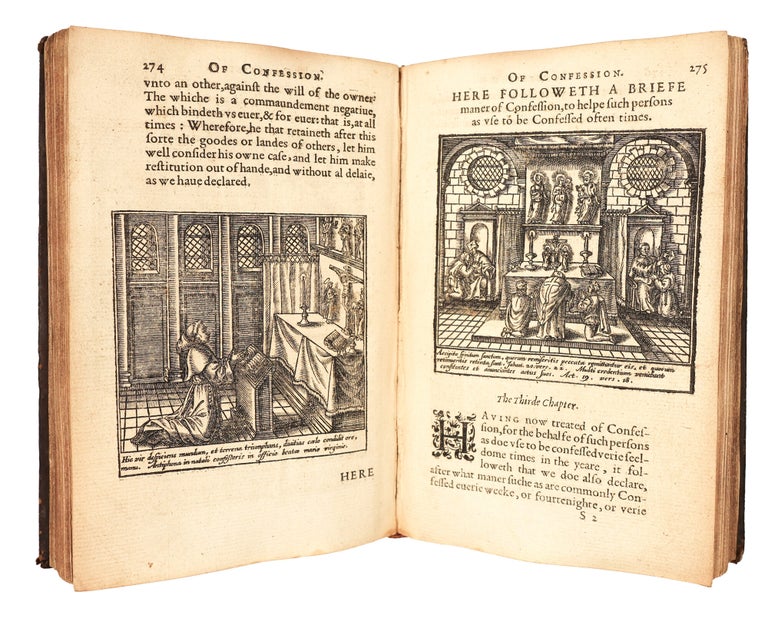
The book contains four narrative woodcut illustrations. The first three woodcuts show a penitent kneeling before a priest within a confessional niche, a kneeling monk at prayer before a furnished altar, and a priest administering the Eucharist to kneeling communicants. The fourth woodcut, which illustrates the final chapter on the imitation of Christ, shows Christ bearing the Cross on the road to Calvary, accompanied by followers who also bear crosses. Several ornamental devices are based on the IHS Christogram enclosed within decorative architectural or cartouche-like frames. These vary in border design, medallion shape, and surrounding ornament, and function as sectional dividers.
A militantly pro-Catholic English-language translation of books 1-4 of Luis de Granada’s 16th c. devotional manual “Memorial de la vida Christiana”, translated by the exiled Richard Hopkins. Granada was a Spanish Dominican who wrote in the vernacular for lay readers because it allowed individuals direct access to spiritual development previously accessible only through the Church. In his polemical dedicatory epistle to his translation, Hopkins presents this book as a remedy for England’s spiritual crisis brought on by the Reformation and encourages the English to turn from heresy toward prayer, meditation, and sacramental devotion. The last three books of “Memorial de la vida Cristiana” were not published in English until 1699.
Luis de Granada’s “fame rests on his books of spiritual guidance (including his devotional manual “Memorial de la vida Christiana”). He aimed to give spiritual guidance for the laity as well as religious. He attributed great importance to the interior life, to mental as distinct from vocal prayer, and saw outward ceremonies as unimportant compared with the inner religious life.” (The Concise Oxford Dictionary of the Christian Church, 2nd ed.)
“Alongside the unabashedly militant content of Hopkins’ (translations of Granada), his long (introductory epistles, addressed) to the Inns of Court best exemplify his pro-Catholic activism. He criticized the Lutheran principle of sola fide, focusing his attacks upon Puritans (‘counterfaicte pure gospellers’) and their ‘sutle wicked doctrine’. He took exception to their suppression of holy days and ceremonies. In the prefatory epistle to ‘A Memoriall of a Christian Life’ Hopkins contrasts the mendacity and wickedness of ‘late Apostates’ – Luther, Zwingli, Oecolampadius, Calvin, and Theodore Beza – with the virtues of St Benedict, St Bernard, St Dominic, and St Francis, who in his account contributed to the true foundations of the Church of England. Hopkins condemned the reformers and their ‘hereticall licentious doctrines’, along with their intention to abolish ‘the Catholicke religion’.
In his Epistle, Hopkins attacks Edmund Bunny (15) and accuses the Church of England of causing “the great defacing of the ecclesiastical state . . . (which is) demonstration of their evil consciences and dishonest lives, and consequently of the evil fruits of their new Calvinistical licentious religion.” (14)
“Hopkins sought to reinforce his militant Catholicism with translations of Luis de Granada, with a view to rekindling those embers of Catholic piety which the Elizabethan ecclesiastical settlement had not entirely smothered. When he addressed his works to the Inns of Court, he expressly declared his intention to provide an example for ‘a greate nomber throughout our whole Realme … to embrace firmelie and Zealouselie the aunciente Catholike beliefe.’ Hopkins’ apocalyptic view of Elizabethan England might be seen as another strategy to instil Catholic ideas into sceptical Anglicans. He talks of the coming of Antichrist, the end of the world, Satan’s diverse ways of tempting the faithful, ‘an ungracious age’, (and) heretical sects.” (Castillo 148-149)
Richard Hopkins
Richard Hopkins, Roman Catholic exile and translator, was admitted to the Middle Temple in 1560. About 1566 Hopkins became ‘wearied with the heresy’ of Middle Temple, according to Anthony Wood, and he went into exile at Louvain, where he was befriended by Thomas Harding.
“Following the advice of Thomas Harding, who had earlier urged Hopkins to undertake the translation of Spanish devotional works as being spiritually more profitable than controversy, he published at Paris in 1582 a translation of part one of the ‘Libro de la oración y meditación’ by the Spanish Dominican Luis de Granada. This was dedicated to the benchers of the inns of court, as was his translation of part one of the same author's ‘Memorial de la vida Christiana’, published at Rouen in 1586. The two works, based on a scholarly recension of the Spanish text, illustrated and designed for the use of the laity, enjoyed wide popularity…
“From 1579 Hopkins was a close associate of William Allen, and he was a leading member of the English Catholic émigré community in Flanders. As Allen's agent Hopkins was possibly involved in clandestine negotiations for peace between England and Spain about 1594. In a report drawn up for the Archduke Ernest, governor of the Low Countries, in 1594, Hopkins was described as ‘a man of great loyalty and zeal in the service of God and the King’. In 1596, having died in Louvain, he was listed as a deceased pensionary of the Spanish crown.”(G. Martin Murphy, ODNB)
Luis de Granada
Luis “professed as a Dominican in Granada in 1525, and the aim of his works written in Castilian was the promotion of meditation as a means to moral instruction. Targeting a more general readership, these commend the Catholic faith to the laity, supported by the conviction that all individuals are destined to attain holiness. In Spain, the increasing proliferation of vernacular writings became a source of great concern because it allowed a direct, individual approach to subjects previously accessible only through the Church and its priests. For this reason among others, Granada’s “Libro de la oración y meditación” and “Guía de pecadores” figured in Valdés’ Catalogus librorum prohibitorum (the Inquisition's index of prohibited books) in 1559”. (Castillo 146).
STC 16903; ESTC S1618; Allison & Rogers, 472; Castillo, Miriam. “Catholic Translation and Protestant Translation: The Reception of Luis de Granada’s Devotional Prose in Early Modern England”, “Translation and Literature”, Vol. 26, No. 2 (Summer 2017), pp. 145-161. See also: Allison “English Translations from the Spanish and Portuguese to the Year 1700” (London: 1970); “Weber, Alison P. “Religious Literature in Early Modern Spain, in The Cambridge History of Spanish Literature”.