

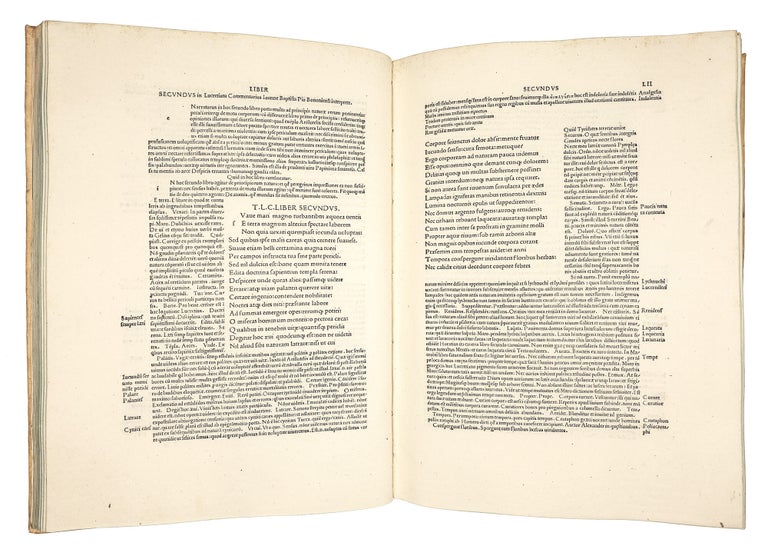


In Carum Lucretium poetam commentarii a Ioanne Baptista Pio editi: codice Lucretiano diligenter emendato
Bologna: typis excussoriis editum in ergasterio Hieronymi Baptistæ de Benedictis Platonici Boniensis [Girolamo Benedetti], 1511.
Price: $18,000.00
Folio: 33.5 x 24.4 cm. [4], CCXXIIII lvs. Collation: [4], A-Z6, AA-NN6, OO8 [4], CCXXIIII lvs. Collation: [4], A-Z6, AA-NN6, OO8
FIFTH EDITION (1st ca. 1473), the first with a printed commentary.
Bound in 18th c. stiff parchment (lightly soiled, with a peppering of wormholes on the spine) with a citron wash label, gilt, on the spine. An excellent, broad-margined copy on heavy paper. Title lightly soiled, some instances of marginal foxing, occasional light marginal stains (toward the end of the text), outer margin of final leaf a little frayed and soiled on verso. Title page set in Gothic type, the text in Roman, with passages of Greek. Printer's device on penultimate leaf. On leaf xlviii, a missing line of text, omitted when the type was set up in the form, was subsequently printed as a correction.
Fifth edition of Lucretius’ “De rerum natura” (On the Nature of Things), printed together with the commentary of the humanist Giovanni Battista Pio (1460-1543), the first full commentary on “De rerum natura” to appear in print.
Lucretius's “On the Nature of Things” is a six-book didactic poem setting out Epicurean physics in full. Books I and II lay the foundation: the universe consists entirely of indivisible atoms (primordia, Lucretius's Latin rendering of the Greek atomoi) moving through a void. Two principles govern everything that follows: nothing is ever created out of nothing, and nothing is ever obliterated. What looks like creation is really just atoms combining into a new arrangement; what looks like destruction is really just atoms dispersing and recombining elsewhere. The total stock of matter is fixed — nothing is added, nothing is annihilated. It is in these two books that Lucretius introduces the atomic swerve (clinamen) — the small, uncaused deviation in atoms' fall that breaks strict determinism and allows for both the chance formation of compound bodies and, crucially, human free will.
In Book III, Lucretius applies this physics directly to the soul. He distinguishes the animus, the rational mind, from the anima, the sentient/vital soul distributed through the body. The animus is not a separate, immaterial substance. It is made of atoms too — extremely fine, swift-moving ones. Because the soul is atomic and material in exactly the same sense that the body is, the two governing principles from Books I–II apply to it directly: the soul did not come from nothing, and at death it is not destroyed into nothingness. It simply comes into being with the body, as those particular atoms combine, and disperses when the body dies, exactly as any other atomic compound disperses when it comes apart. This is what makes the soul mortal — not some special catastrophe reserved for the soul alone, but the same ordinary physical process that governs everything else in the universe.
In Book III (starting around line 231), Lucretius describes the soul (or more precisely the anima) as a physical mixture of four things: air, "vapor" (a kind of heat), breath (aura), and a fourth component that he says has no name — it's simply too fine, too mobile, and too imperceptible to be captured by ordinary vocabulary. Lucretius's own line is that "a fourth nature also must be added to these, one wholly without a name" (quarta quoque his igitur quaedam natura necessest / adtribuatur, east omnino nominis expers, III.241–42). He says this fourth thing is what actually generates sensation — the "motions that bring sense" (sensiferos motus) — meaning it's the component responsible for the soul's capacity to feel and perceive at all, even though it's the most elusive of the four ingredients.
This has always been a difficult passage to interpret and scholars cannot agree on whether it is meant to be something like pure motion itself, or a distinctive kind of atom, or simply the emergent product of the other three when combined in the right proportions. Ancient critics of Epicureanism seized on it as a weak point — an unnamed, undefined fourth substance looks suspiciously like an admission that the theory doesn't fully work.
In his 1511 commentary on the poem, the humanist Giovanni Battista Pio (1460-1543) tackles these issues of matter and soul.
In her study "La question de la mortalité de l'âme dans les commentaires humanistes de Lucrèce de G.B. Pio et D. Lambin,", Susanna Gambino Longo discusses Pio’s commentary on Lucretius at length and credits him with taking the Lucretian fourth-nature problem seriously as a piece of Epicurean physics rather than treating it purely as a doctrinal error to be refuted (a Christian audience would have been troubled, to say the least, by the assertion that the soul was not immortal).
When considering Book III of De rerum natura, Pio spends considerable time discussing Lucretius’ central and most provocative argument: that the soul is made of matter, just like the body, and that it dies along with the body. There's no afterlife, no separate immortal soul — for Lucretius, this is actually good news, because it means we shouldn't fear death.
Pio, rather than skipping past this or explaining it away, engages with it directly and at length, essentially turning part of his commentary into a full philosophical debate on the soul.
He brings in Thomas Aquinas's arguments for why the soul must be immaterial and immortal, and works through them carefully. He also discusses other ancient and medieval thinkers who took more materialist positions closer to Lucretius's own — like Alexander of Aphrodisias, who thought the intellect arose from the body's physical makeup, and the physician Galen, who linked the soul to bodily temperament. Pio treats these as views Aquinas had already refuted, but the fact that he includes them shows he wanted to give the materialist side a fair hearing before knocking it down.
The most interesting move, according to Gambino-Longo, is that Pio brings in Duns Scotus, who had argued that the soul's immortality actually cannot be proven by reason — it has to be taken on faith instead. Pio uses this to soften the blow of Lucretius's argument: if even a respected Christian theologian admits that reason alone can't prove the soul is immortal, then Lucretius isn't doing anything uniquely dangerous by reaching a different conclusion. He's just a pre-Christian poet working within the limits of unaided human reason, not a heretic attacking the faith.
The commentator:
Giovan Battista Pio taught rhetoric at Bologna starting in 1494, then moved to Bergamo in 1495. His reputation for handling archaic and late-antique Latin authors, developed under his teacher Filippo Beroaldo the Elder, led to his next post: Mantua, where he taught publicly for eight months before being appointed private tutor to Isabella d'Este Gonzaga in September 1496. The appointment was brief. By 1497 Pio had moved to Milan, where he taught until 1500, joining the humanist circle around the Academy founded by Ludovico il Moro. When Ludovico's regime fell in 1500, Pio returned to Bologna, where he remained until 1511 and produced the Lucretius commentary that established his reputation.
After completing the Lucretius commentary in Bologna, Pio moved to Rome, where he taught at the Sapienza from 1512 to 1526. During this period he continued producing editions and commentaries on Latin authors: a commentary on Lucan's Pharsalia (1514), a second edition of his Plautus commentary (1518), and an edition of Valerius Flaccus's Argonautica (1519), among others. From 1527 to 1537 he held a position at the Conservatorio in Lucca, his final known post. He also produced an edition of Cicero's Epistolae ad Atticum (1527). He died sometime after 1534, perhaps at Rome or Lucca.
EDIT 16 CNCE 32597; Adams L-1648