

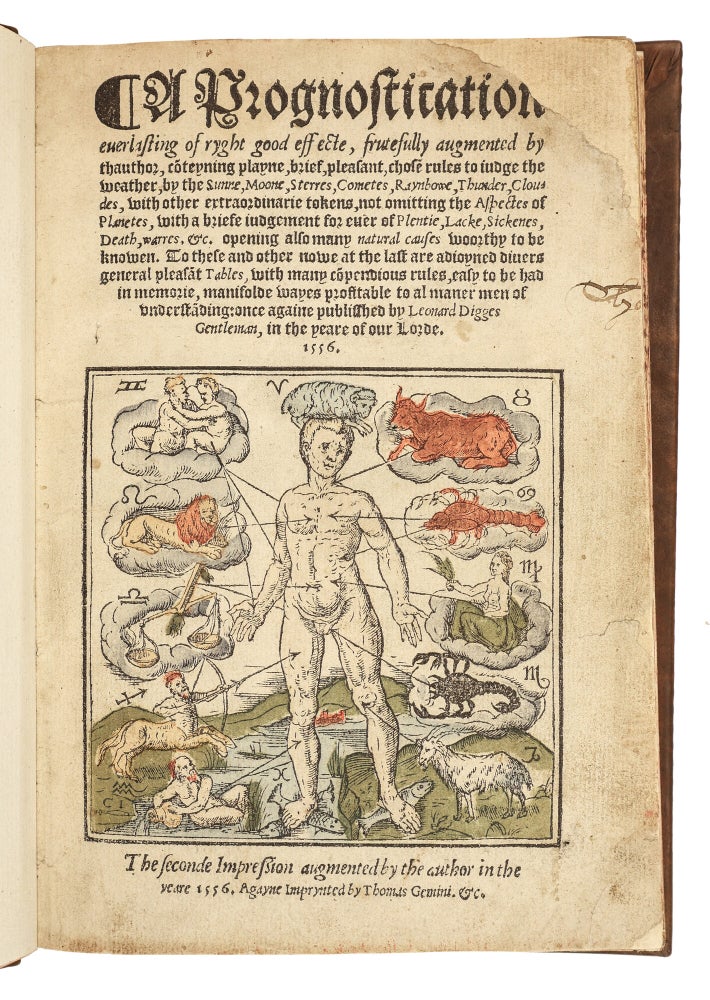


A Prognostication everlasting of ryght good effecte.
London: Thomas Gemini, 1556.
Price: $45,000.00
Quarto: 20.5 x 15 cm. [2], 31, 28-31, 35-41 l. Collation: π2, A-G4 (-G4 blank), Aa-Cc4, Dd4 (with Dd4 blank)
SECOND EXTANT EDITION. “The seconde impression augmented by the author in the yeare 1556.” The earliest surviving edition of this almanac is dated 1555, though in that work Digges refers to an even earlier version from 1553.
Bound in modern calf by Bernard Middleton. A fine copy on thick paper with minor defects. The book is illustrated with a woodcut zodiac man (hand-colored in this copy) on the title, numerous woodcut instruments, diagrams, and illustrations that include a model of the Geocentric Solar System, and an illustration showing the relative sizes of the planets and the Sun. There are woodcut initials throughout. The upper, outer corner of first 5 leaves with discreet repairs, partially costing a letter on the title and one letter on three of the other leaves. A few diagrams and side notes are slightly shaved. The final blank leaf is repaired at the corners. A 17th c. owner has added additional dates (for the years 1633-1641) on two of the lunar tables. The Harrison D. Horblit copy (his sale, 16 February 1994).
One of the earliest scientific books printed in England and one of the earliest English books on scientific subjects composed in the vernacular. The author, the mathematician Leonard Digges, wrote the book in English in order to render mathematical and scientific knowledge accessible to artisans, mariners, craftsmen, surveyors, and physicians.
In part a perpetual English almanac, with meteorological rules, calendrical tables, and medical and astrological guidance; the book also includes information crucial for navigation, including tide tables for 37 ports, and instructions for the construction and use of scientific instruments. The book is illustrated with woodcut illustrations, including of the geocentric cosmos with the relative sizes of the planets, multiple instruments, an “astrological man”, etc. This almanac would achieve numerous editions. It served as inspiration for his son Thomas Digges’s 1576 supplement in which he provided the first English translation of any part of Copernicus.
“Digges's almanac deliberately departed from the usual form of such texts, which were typically printed for a single year and required annual renewal. The ‘Prognostication’ has calendrical tables and explanations of meteorological phenomena, with basic astrological information and rules for predicting the weather as well as times for planting, grafting, and blood-letting. Digges discussed the use of instruments such as the quadrant and square for time-telling, and provided tide tables for mariners. To satisfy readers who doubted the possibility of the astronomical statements in his early editions he included diagrams of the geocentric world system and of the relative sizes of the planets.” (ODNB)
“The ‘Prognostication’ was in fact intended to be especially serviceable to sailors, containing as it did the data necessary for finding the hour of full sea at thirty-seven ports in the Narrow Seas. A table of the sun's altitude for every hour throughout the year in the latitude of London made it possible to find latitude on shipboard by simple comparison, without reference to the sun's declination. The latter was in fact given for every five degrees of the sun's passage through the signs of the zodiac, for Digges (as the title of his almanack suggests) attached great importance to astrology, which in turn involved attention also to horology and the making of accurate dials. The very practical intention of his publication is further indicated by the inclusion of a description of the making and use of three quite simple instruments, a dial, a quadrant and a square, the last named in effect providing a rough solution for the tangent of any angle.
“Digges's avowed aim was to bring within the reach of the artisan and the master-craftsman a knowledge of the mathematical arts which had hitherto been 'locked up in strange tongues', and the fact that his books were so many times reprinted, as well as the numerous references made to them by men of the class and type he hoped to reach, is evidence of their value. He was ably seconded by Thomas Gemini, who made the instruments that he described” (Taylor 23)
“Leonard Digges was a mathematical practitioner specializing in surveying, navigation and gunnery. . . ‘A Prognostication Everlastinge’ was, at heart, a treatise on meteorology as its fuller title indicates: ‘A prognostication everlastinge of righte good effecte, fruitfully augmented by the auctour, contayning plaine, briefe, pleasante, chosen rules to judge the weather by the Sunne, Moone, Starres, Comets, Rainebow, Thunder, Cloudes, with other Extraordinary Tokens, not omitting the Aspects of Planets, with a briefe judgment for ever of Plenty, Lacke, Sickness, Death, Warres . . .’ Clearly the author's intention was to bring an astrological-scientific perspective to bear on weather-forecasting. So it is understandable that a typical microcosm-macrocosm engraving relating the signs of the zodiac to the different parts of the human body was strategically placed on the title page and that all sorts of 'rules' for weather-forecasting, like the significance of the day of the week on which the new year fell, were outlined. But what is particularly significant is that Digges was concerned no less to safeguard the propriety of astrology than to defend the rectitude of astronomy.”(Livingstone 363)
“Digges was born to a well-established family and educated at Oxford. He was implicated in Thomas Wyatt’s 1554 revolt against the marriage of Queen Mary, charged with treason and sentenced to death, though later pardoned. In addition to his almanac, Digges wrote extensively on mensuration, “Tectonicon” appeared in 1556, advertised on its title-page as a book for surveyors, 'landmeters', joiners, carpenters, and masons’. “Pantometria”, a text on practical mathematics, appeared posthumously in 1591 and covered the measurement of length, area, and volume and showed Digges's familiarity with the latest continental sources. He also wrote on military mathematics, artillery, and ballistics. Through his promotion of the mathematical arts and his claims for the civic utility of practical geometry, he was a key figure in the establishment of the role of the mathematical practitioner.”(ODNB).
ESTC S116106; STC (2nd ed.), 435.39; Luborsky & Ingram, “English illustrated Books 1536-1603”, 435.39; Taylor, E. G. R., “Mathematical Practitioners of Tudor and Stuart England” (Cambridge: 1954); Livingstone, David. "Geography, Tradition and the Scientific Revolution: An Interpretative Essay," Transactions of the Institute of British Geographers, Vol. 15, No. 3 (1990)