

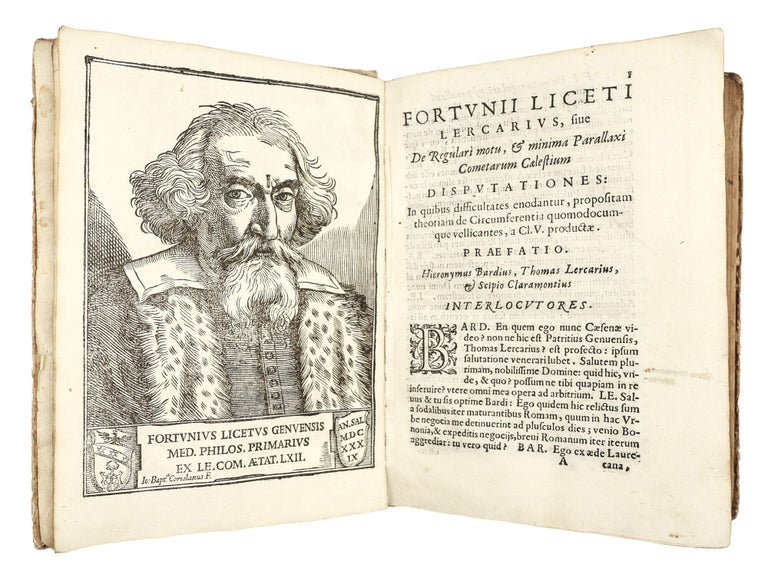


Sammelband of Five Works by Fortunio Liceti: “De regulari motu minimaque parallaxi cometarum caelestium disputationes,” “De terra unico centro motus singularum caeli particularum disputationes,” “De centro, & circumferentia libri duo,” “De natura, et arte libri duo,” “De luminis natura & efficientia libri tres”.
Udine: (all five works) Nicola Schiratti, 1640.
Price: $20,000.00
Quarto: 19.5 x 14 cm. I. a4, A-4, Aa-Ee4; II. a4, A-S4; III. a4, b2, A-O4, P2; IV. a4, A-I4; V. a6, A-Z4, Aa-Ee4. Gatherings A-N in parts III and V bound transposed.
FIRST EDITIONS OF ALL BOOKS.
Bound in contemporary carta rustica (light soiling and small stains.) Fine, fresh copies internally with occ. reader's pencil ticks in some blank outer margins and some blemishes as follows: First work with some damp-staining in the lower margin, leaves D2-D3 with ink stains. In the fourth, gathering F is lightly toned, F4 has a marginal hole in blank lower margin, and that same leaf and G1-2 have a marginal stain. There are a few stains, a few ink marks and a little light soiling in the final work. The first four books include a full-page woodcut portrait of the author. With an older printed label of Venetian ecclesiastical library With the stamps of the Collegio Antonianum, Padua (this institution was dissolved and the library dispersed).
A sammelband of five books by the scientist and natural historian Fortunio Liceti, who advanced the new science of experimentation. Liceti engaged in various scientific controversies with his friend Galileo (in this volume, Liceti includes three printed letters from Galileo and a detailed account of an experiment conducted by him) and wrote in support of the theories of Tycho Brahe. He participated in the long-running debates over the center of the universe and the nature and location of comets. Despite being an Aristotelian, Liceti recognized Copernicus as a major astronomical authority. In the five publications in this volume, Liceti concentrated on problems in astronomy, mathematics, and the physical investigation of light.
In the first work, Liceti attempts to refute Scipione Chiaramonti’s theories regarding comets, defending some of Tycho’s theories and discussing Tycho’s criticism of possible errors by Copernicus. The second work is Liceti’s defense of the idea that the Earth is the single center of celestial motion (it is in this work that we find the Galileo). In it, Liceti continues his dispute with Chiaramonti on the location of comets, defending important elements of Tycho’s observations and arguments.
In the third book, written in the form of a dialogue, Liceti uses geometry, mechanics, natural motion, and cosmology in a systematic investigation of the concept of centers (geometrical, physical, and mechanical) and circumference (mathematical, physical, and mechanical). His treatment of mechanics extends to the balance, lever, pulley, and other devices. The fourth book is a mock trial between personifications of Art and Nature, each of which pleads its rival claims to nobility and primacy, with Liceti sitting as judge. The final work is a treatment of the physics of the nature and action of light, and includes an account of Galileo’s experiment on stones that became luminous after exposure to light and continued to shine when returned to darkness (please see below).
I. “De regulari motu minimaque parallaxi cometarum caelestium disputationes”
Here Liceti engages in the decades-long controversy over whether comets are “supralunary” phenomena (i.e., cosmic or “celestial” objects) or “sublunary” (i.e., objects that occur between the orbit of the moon and Earth). The controversy formed part of the broader debate over celestial novae and comets shaped by Tycho Brahe’s observations of the new star of 1572 and his arguments for the celestial location of the comet of 1577. This work constitutes a sustained reply to Scipione Chiaramonti’s criticisms of Tycho and Liceti. Liceti repeatedly invokes Tycho and Kepler, and discusses the theories of Galileo, Aristotle, and Ptolemy. Liceti also discusses Tycho’s criticism of possible errors in Copernicus’s determination of the Sun’s apogee and eccentricity.
II. “De terra unico centro motus singularum caeli particularum disputationes”
In this work Liceti defends the idea that Earth is the center of the universe, with all the celestial bodies revolving around it. Here he includes the three letters from Galileo. He continues his controversy with Chiaramonti, responding to arguments advanced in Chiaramonti’s three tracts “On the Sublunary Location of Comets”. Liceti’s book is considered “an extreme attempt to defend geocentrism and the superiority of Peripatetic cosmology against the new Galilean theories, while nevertheless showing a tentative openness to the problems of the new science.” (Ongaro, Treccani Enciclopedia)
The three letters from Galileo are dated between 1622 and 1639. In the first (30 July 1622) Galileo acknowledges receipt of Liceti’s “De novis astris et cometis”(On Novas and Comets) calling it an “Atlantean labor,” and discusses his own forthcoming reply to Orazio Grassi’s “Libra astronomica e filosofica”, a book written in response to “Discorso delle Comete”(Discourse of the Three Comets of 1618-1619). Galileo also reveals to Liceti that Mario Guiducci was the principal author of the “Discorso”, despite the fact that it was commonly attributed to Galileo. In the second letter (24 September 1639), Galileo responds to Liceti’s discussion of the size of the universe: Galileo states that neither the arguments for a finite nor an infinite universe seem demonstrative to him, though his own reasoning inclines him toward infinity, and he treats the question as perhaps beyond the reach of human reasoning. In the third (24 December 1639) Galileo asks Liceti to explain his objections to Galileo’s theory that the Moon’s secondary illumination is caused by sunlight reflected from the Earth. Liceti then includes his own reply of 3 January 1640. In the letter, he maintains his disagreement with Galileo while directing him to chapter 50 of his ‘Litheosphorus’ for an explanation of his objections. Later, he calls Galileo the “Prince and Father” of mathematics in their age.
III. “De centro, & circumferentia libri duo”
Liceti’s systematic investigation of the concepts of center and circumference, presenting them as fundamental to both natural philosophy and mathematics. Written in the form of a dialogue, Liceti speaks as the “Philosophus Eminens” to a group of named young Genoese pupils. The first book discusses geometrical centers, physical centers connected with gravity and motion, and mechanical centers. Liceti’s treatment of mechanics extends to the balance, lever, pulley, and other machines, as well as the traditional account of Archimedes’ burning mirrors.
IV. “De natura, et arte libri duo”
Liceti stages a mock trial between personified Art and Nature, who plead their rival claims to nobility and primacy before Liceti, who acts as judge. Art argues that its activities can be considered prior to those of Nature, claiming that God first acted as an artificer in creating the world. Nature answers these claims, arguing that Art depends upon preexisting natural things and therefore cannot take precedence over Nature.
V. “De luminis natura & efficientia libri tres”
One of several treatises by Liceti concerning the nature and action of light. It includes a detailed account of an experiment by Galileo, reported by Giulio Cesare Lagalla, concerning stones that became luminous after exposure to light and continued to shine when returned to darkness. Galileo placed the stones in a wooden box and showed them first by candlelight and then in complete darkness, establishing that they possessed no visible luminosity of their own. The box was then placed outside at daybreak, where the stones were exposed not to direct sunlight but to the weak, secondary light of morning twilight. After a short interval, the window was closed again, the room was again darkened, and the stones were found to shine visibly without any perceptible heat, and their light gradually weakened until it disappeared.
Riccardi I pt 2 39 nos 4-7; Carli and Favaro 176 and 178; DiLaura 83; Zoubov, Vasily. "Une théorie aristotélicienne de la lumière du XVIIe siècle," Isis vol 24 n 2 (1936), pp 343-60; Ongaro, Giuseppe. “Fortunio Liceti” Treccani Enciclopedia