

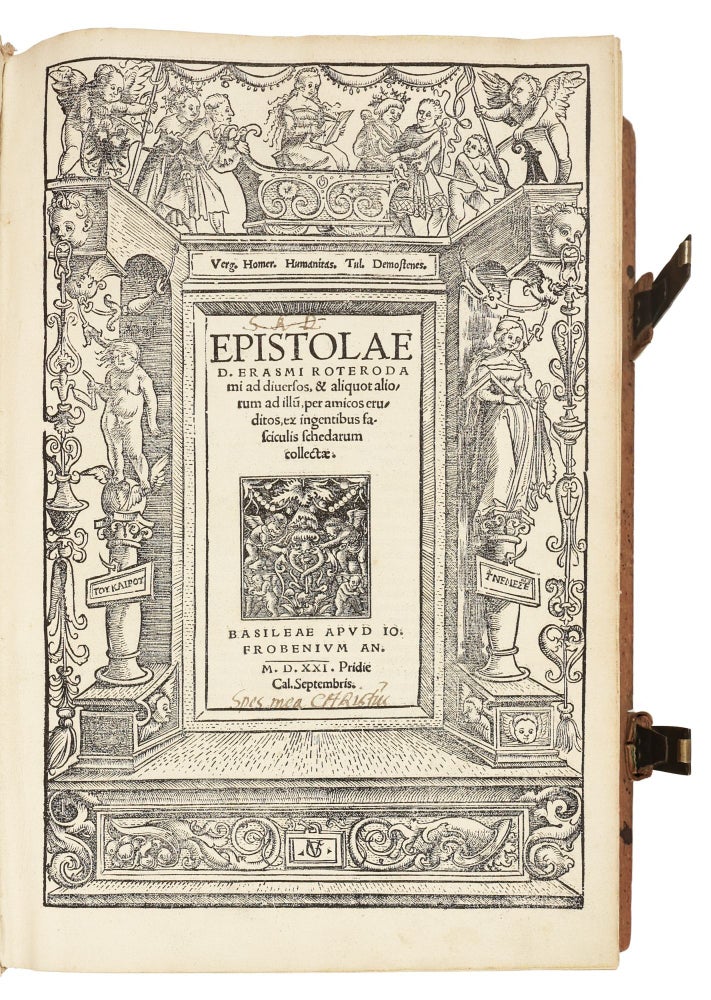


Epistolae ad diversos, & aliquot aliorum ad illu(m) per amicos eruditos, ex ingentibus fasciculis schedarum collectae.
Basel: Johann Froben, August 21 1521 - January, 1522.
Price: $16,500.00
Folio: 30 x 21 cm. 12, 668 (i.e. 670), [6]p. Collation: alpha 6, a-z6, A-Z6, Aa-Kk6, π2 (errata)
FIRST EDITION.
A superb copy bound in contemporary alum-tawed pigskin over beveled wooden boards, ruled and tooled in blind , with the original clasps, catches, and straps preserved. Binding mildly soiled, a few scrapes, mild surface wear. Internally crisp and bright, with just a few lightly toned leaves and a few trivial stains. With 16th c. manuscript annotations scattered throughout and a 16th c. ownership inscription on the paste-down. The errata lvs. have been tipped in, possibly indicating early issue. Excellent.
Title page with the fine ‘Triumph of Humanitas’ historiated woodcut border by Urs Graf (Lüthi 50a and Hieronymus, Oberrheinische Buchillustration 172) enclosing Froben’s printer’s device; two preliminary pages with fine four- and five-piece woodcut borders by Ambrosius Holbein; white-on-black woodcut headpiece, two 10-line woodcut initials and numerous smaller ones, verso of final leaf with large printer’s device enclosed in five-piece woodcut border; some Greek printing.
First edition of this collection of 671 letters, of which 171 are newly printed. The majority of the new letters are from 1519-1521, but some are earlier, the first dated 11 July 1513. The collection is far larger than its predecessors: the ‘Epistolae aliquot’ of January 1518 (52 letters), the ‘Auctarium’ of October 1518 (63 letters), and the ‘Farrago’ of Nov 1519 (333 letters).
Erasmus provides a preface to his correspondence for the first time in this edition. The letter to his editor Beatus Rhenanus (Ep 1206) tells of his dislike of two earlier collections edited by him (Beatus) and published by Froben, the ‘Auctarium’ of October 1518 and the ‘Farrago’ of Nov 1519, and implies that they were published surreptitiously without his consent. After the present edition no further collections were printed until the ‘Opus epistolarum’ of 1529.
The introduction in the Collected Works to Erasmus’ prefatory letter to Beatus Rhenanus illustrates his personal involvement in the production of this collection:
"Even as the Farrago was being printed Erasmus spoke of another edition with new letters added and others revised... The last thing he desired was a straight reprint either by Froben or another publisher. So in the summer of 1520 he was going through all his letters and in November the review of the ‘Farrago’ was apparently completed. Before the middle of January 1521 the revised copy together with a substantial number of new letters had reached Basel. When he sent the first part of the revised New Testament shortly afterwards he apparently asked to have all letters, old and new, back for another review, but was sent none and told instead that a volume of 41 quires (pages 1-490) was set in type, lacking only a preface and an epilogue. So he wrote this preface as well as dispatching more letters to Basel.
“Froben next prepared a preliminary quire containing the title-page (dated 31 August), Epp 1206, 1225, and, to fill some space left over on the last page, Ep. 1239. All was printed and ready to be launched at the Frankfurt autumn fair, but with the certain prospect of Erasmus’ return to Basel a delay was indicated. As Froben now preferred his volume not to reach the public and his rivals until the time of the spring fair of 1522, Erasmus could add more letters including the last in time dated from Basle 22 November 1521, which appears on page 639 but is followed by thirty more pages of letters. Presumably as a result of Erasmus’ review of the printed volume, over three pages of corrigenda were added at the end" (Collected Works , vol. 8, pp. 215/7).
The correspondents for the newly printed letters include Johann Reuchlin, Justus Jonas, Guillaume Bude, Petrus Mosellanus, Polydore Vergil, Pope Leo X, Cardinal Albert of Brandenburg, Thomas More, William Warham, Thomas Wolsey and John Fisher. Many of the letters reflect Erasmus’ changing stance regarding Luther but, at the same time, continue his attacks on the friars and Louvain theologians.
Bietenholz singles out a long letter of 10 May 1521 (Ep 1202) to Justus Jonas as one of the finest of the period, in which Erasmus expresses his alarm that Jonas, as well as a whole group of German humanists, especially Melanchthon, are committing themselves irrevocably to the Lutheran cause (Collected Works , vol. 8, pp. 201). Another letter to Jonas of June 1521 (Ep 1211) holds an important biography of his friend John Colet, the humanist and educational pioneer, who had died in September 1519, “Sixteenth-century Europe’s image of Colet owes everything to Erasmus. Much is still today known only from that source. Erasmus’ encomium is the fullest and most explicit portrait...” (Contemporaries of Erasmus , I, p. 327). Also included in this collection, and previously published in the Farrago, is one of Erasmus’ most famous letters “which will always rank among his finest writing and the great accomplishments of Renaissance literature” (Collected Works, vol. 7, p. xii). Addressed to Ulrich von Hutten in July 1519 (Ep 999), it contains Erasmus’ intimate pen portrait of his close friend Thomas More. It serves as earliest biographical account of More and is the most substantial of three letters (the others Ep 1233 see below & Ep 2750) “which are indispensable for any historical assessment of More’s character” (Contemporaries of Erasmus II, p. 458). It is full of memorable phrases such as, “in a word, if you want a perfect model of friendship, you will find it in no one better than in More” and “no one is less led by the opinions of the crowd, yet no one departs less from common sense”. The friends met for the last time in Bruges in August 1521 and in his letter to Budé (Ep 1233), first printed here, Erasmus writes of the invigorating impact of their meeting and of the shining example set in More’s household for the education of women.
VD16 E-2925. Adams E-852. Allen I, appendix VII, p. 600, no. F. Van der Haegen p. 99. Bezzel Erasmusdrucke no. 1003 Ref: Collected Works of Erasmus, Correspondence vols 7 & 8.