

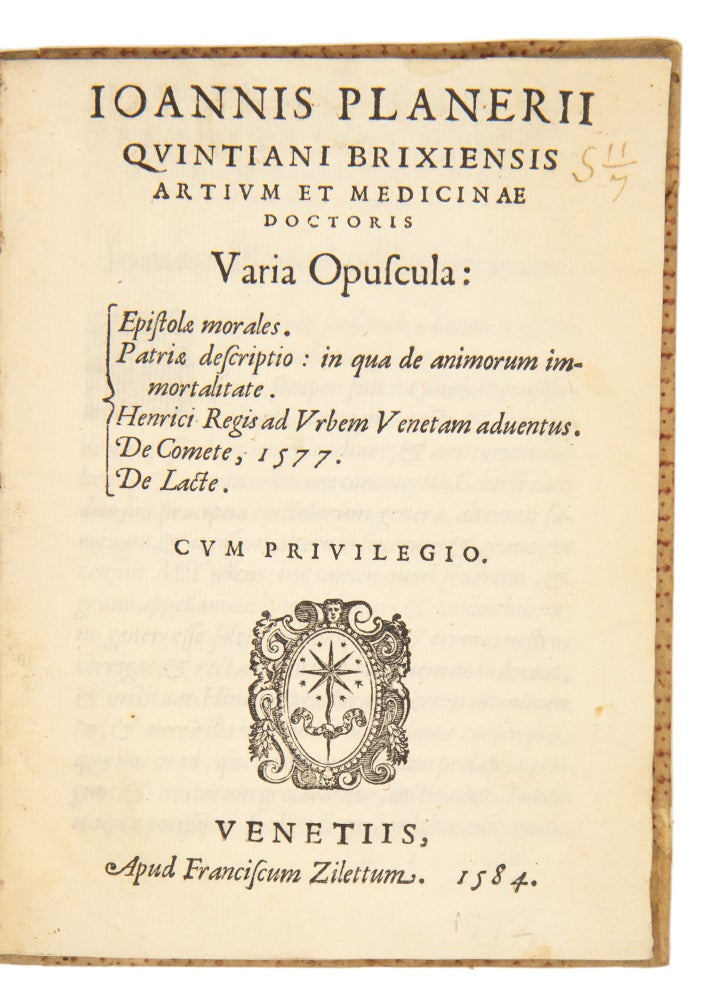


Ioannis Planerii Quintiani Brixiensis artium et medicinae doctoris Varia opuscula. Epistolae morales ; Patriae descriptio : in qua de animorum immortalitate. Henrici regis ad urbem Venetam aduentus ; De comete , MDLXXVII ; De lacte.
Venice: apud Franciscum Zilettum, 1584.
Price: $5,800.00
Quarto: 18.5 x 13.6 cm. [4], 32; [2], 24 lvs. Collation: a4, A-H4, a-f4
SOLE EDITION.
Bound in 18th c. quarter vellum and patterned paste-paper. A fine copy. Small stain to leaf H4 and margin of b3, very pale dampstain to two gatherings. Woodcut printer’s devices on main and divisional title page. Rare. 5 copies traced in North America: Hagley Museum, Michigan, Newberry, NLM, Columbia.
A very rare compilation of works by the Brescian physician and scientist Giovanni Planerio of Quinzano d’Oglio. Included are treatises on the medicinal benefits of milk (including for the treatment of tuberculosis), herbal remedies for constipation and urinary complaints, a description of the plague outbreak that afflicted his home town in 1529, and a discussion of the adverse health effects purported to have been brought on by the appearance of the comet of 1577.
Planerio regards milk as both nourishment and medicine. He compares the relative nutritional and medicinal properties of the milk of humans and various animals, establishing the following ranking: human milk first, ass’s milk second, and goat’s milk third, while rejecting cow’s and sheep’s milk as having little medicinal value. Human milk, he notes, is preferably taken directly from the breast.
In his “Letters on Morals and Conduct”, Planerio recommends a number of remedies for urinary complaints, including preparations using sheep’s milk, asparagus, fennel, and parsley; and a popular drink made with honey. For constipation, he recommends barley infusions and laxative pastes, as well as daily exercise.
Planerio next gives a thorough account of the plague outbreak in his hometown of Quinzano d’Oglio in 1529. “He described the wailing and moaning and finally how people became accustomed to ever-present death, the absence of funerals as people were buried in mass graves that were covered by so little earth that the stench of the corpses seemed to be quite literally poisoning the air.” (Stolberg, Learned Physicians and Everyday Medical Practice in the Renaissance, p. 100)
Pianeri also offers a detailed examination of the Great Comet of 1577, a significant astronomical event that captivated observers across Europe and beyond, and considers its role as a portent of disruption. This comet was notable not only for its brightness but also for the role it played in challenging prevailing astronomical theories of the time.
Planerio discusses the calamities believed to follow from such celestial configurations, including war, famine, political upheaval, mortality, and disease. Among the specifically medical effects attributed to comets are acute fevers and bodily pains, sometimes so severe as to lead to death.
The Great Comet of 1577 appeared unexpectedly and was visible to the naked eye, prompting widespread observation and documentation. Its sudden appearance and striking presence spurred debates among astronomers and philosophers regarding the nature and origin of comets. Prior to this event, the Aristotelian view predominated, positing that comets were atmospheric phenomena occurring within the Earth's atmosphere. The observations of the 1577 comet, however, provided evidence that challenged this perspective, suggesting that comets were celestial bodies located beyond the Moon.
The Great Comet of 1577 was first observed on November 1, 1577, in Peru. In Europe, sightings began around November 7, 1577, with notable observations by Tycho Brahe starting on November 13, 1577. The comet remained visible to the naked eye until March 1578.
In his treatise, Pianeri meticulously documents the comet's appearance, trajectory, and duration. Based on his own data and observations made by Tycho Brahe, Michael Maestlin, and Cornelius Gemma, Pianeri assesses the comet to be a supralunary phenomenon, occurring in the celestial rather than atmospheric realm.
Pianeri records that he first observed the comet on November 10, 1577, in the constellation of Sagittarius. His observations continued through early December. From its initial observed position in Sagittarius, the comet moved through Capricorn and Aquarius, approaching Pisces around December 1.
He provides detailed observations of its brightness and the length of its tail. The comet was exceptionally bright, comparable to Venus, with a well-defined nucleus exhibiting a slightly reddish hue. The comet's tail extended up to 30 degrees across the sky on November 15, slightly curved with a pale yellowish color, gradually decreasing to about 15 degrees by December 1. The comet remained visible from Pianeri’s vantage until December 5, 1577, with its brightness diminishing over time.
The Arrival of Henry III at Venice
Planerio gives a detailed account of Henry III’s passage through Venice in July 1574 on his return from Poland to assume the French crown. He describes the elaborate Venetian reception, including the king’s ceremonial entry, triumphal architecture, processions in the Bucentaur, religious observances, banquets, illuminations, musical performances, glassmaking demonstrations, visits to the Arsenal and other civic institutions, dances, and public entertainments. The work is particularly rich in descriptions of Venetian pageantry, architecture, material display, and civic ceremony, culminating in Henry’s departure from the city on 27 July.
EDIT 16 CNCE 40659; Adams, P1396