



Veteres Vicentinae urbis atque agri inscriptiones, per Bernardinum Trinagium, nunc primum in lucem editae
Vicenza: Ex typographia G. Angelerii, 1577.
Price: $3,800.00
Quarto: 18.7 x 13.7 cm. [64] p. Collation: A-H4
SOLE EDITION.
Bound in modern boards. A very nice, crisp copy, title lightly soiled and with small burn hole, leaves A4 and D4 with light stains, blank verso of final leaf with contemporary annotations (light shine-through on recto). Elaborate woodcut printer’s device on title. With decorative woodcut borders throughout. EXTREMELY RARE. I have traced only 1 copy in North America (Stanford.).
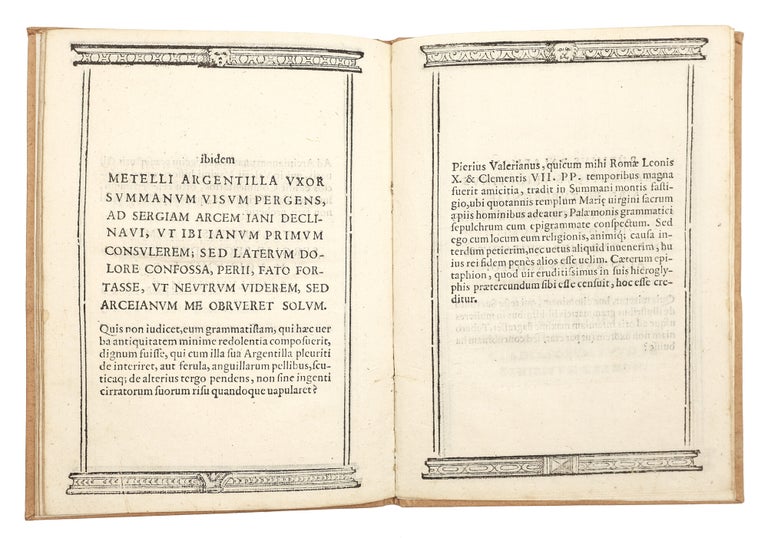
Each page has a decorative woodcut border. The lapidary inscriptions are reproduced in type, using Roman capitals. Explanatory text (location of the inscriptions, expansions of abbreviations, etc.) are printed above or beneath the inscriptions in smaller type. On the verso of the final leaf is a near-contemporary register of northern Italian city histories in which ancient inscriptions are recorded, demonstrating an early reader’s engagement with numerous texts. See below for details.
A very rare epigraphic work by the Veronese humanist Bernardino Trinagio, member of the exclusive Accademia di Costozza and a founder of the Accademia Olimpica. Trinagio was the first to publish the majority of these inscriptions.
Some of the inscriptions are known to be later fabrications, something that Trinagio suspected in certain cases. In assessing an inscription (CIL V, 341*) now known to be a Renaissance “forgery” -really a humanist exercise- honoring a woman named Argentilla, who died after experiencing a strong pain in her side (characteristic of pleurisy). Trinagio writes:
"Who would not judge that the schoolmaster who composed these words — which scarcely smell of antiquity at all — deserved either to perish of pleurisy along with his beloved Argentilla, or else, strung across another's back, to be beaten now and then with a cane, with eel-skins, and with a whip, not without the enormous laughter of his own curly-headed pupils?"
In his dedicatory epistle, Trinagio explains that he and his friends sought to gather the inscriptions because others had failed to do so. We are treated to picturesque glimpses of Trinagio’s trips to track down inscriptions, some of which end in disappointment. He grieves, for instance, “that a great part of those [inscriptions] which used to be seen at the shrine of Saint Felix — where the stags shed their antlers — have been moved away from there.” In discussing an inscription, he reminisces:
“Pierius Valerianus -with whom I enjoyed great friendship at Rome in the times of Popes Leo X and Clement VII- reports that on the summit of Monte Summano, where each year a temple sacred to the Virgin Mary is visited by pious people, the tomb of the grammarian Palaemon was to be seen, together with its epigram. But although I myself sought out that place from time to time, both for religion's sake and out of curiosity, I found nothing ancient there.”
Trinagio dedicated his 1577 collection to Matteo Priuli, then Bishop of Vicenza. In his prefatory letter he states that friends — among them Elio Bello and Valerio Barbarano — had repeatedly urged him to gather the ancient inscriptions of the city and the surrounding countryside and publish them, and he presents his motivation partly as one of local pride wounded by neglect: he complains that Pietro Apiano, in his vast collection of ancient inscriptions and epitaphs from across the world, made no mention whatsoever of Vicenza's, and that the eminent Paolo Manuzio — whom Trinagio had known personally in his youth in Venice, in the household of his teacher Egnazio — likewise catalogued the Roman voting tribes attested on surviving stones city by city without noting examples preserved at Vicenza.
Trinagio frames his book as answering this neglect, insisting that Vicenza deserves recognition not only for the antiquity of its origins but for the epigraphic record itself, which he says he and his circle "sought out with great labor" and rescued "from obscurity and neglect" so that it might appear in print under the bishop's name.
Trinagio states that the inscriptions came from two sources — those he had personally seen "impressed on monuments" and those he had received from friends. He does not claim to have inspected every text himself, and he acknowledges in advance that some entries would be found "mutilated and corroded" or "poorly arranged," attributing these defects partly to the damage of time and partly to the carelessness of unskilled transcribers who had handled the material before him. He also gives a concrete, personally-witnessed episode illustrating his direct engagement with epigraphic preservation, independent of the book itself: some twenty-two years earlier, while presiding over Vicenza's Accademia Olimpica, he had tried — through an appeal to the Academicians and town councillors, seeking a bishop's decree and a magistrate's edict — to stop ancient inscribed pavement and marble tombs, unearthed during renovation work at the church of San Feliciano, from being carried off elsewhere; he reports that the effort mostly failed, since, as he wryly puts it, "votes are counted, not weighed," and few followed his advice.
Some of the inscriptions are now held in the Museo Civico of Vicenza, such as a mid-1st c. epitaph for a tomb erected by the freedman Lucius Cassius Proculus for himself and his wife, Theodora.
Manuscript list of References:
On the verso of the final leaf is a manuscript list with references to printed works in which inscriptions from various northern Italian cities (Parma, Ravenna, Padua, Brescia, Bergamo, Como, Milan, Rimini, and Verona) are to be found. Book eight of the Historia Parmensis (“La Historia della Città di Parma”) of Bonaventura Angeli is cited as the source for inscriptions of Parma. Book three of the De Amplitudine, Vastatione, et Instauratione Urbis Ravennae, Libri Tres of Desiderio Spreti is cited for inscriptions from Ravenna and its environs. Book one of the De Antiquitate Urbis Patavii et Claris Civibus Patavinis of Bernardino Scardeone for the antiquities and inscriptions of Padua and its territory. The Brixia Antiqua (of Giovanni Battista Gerini?) for the antiquities of Brescia. Book three of the De Origine Orobiorum sive Cenomanorum ad Petrum Bembum, Libri Tres of Giovanni Crisostomo Zanchi for the antiquities of Bergamo. La Nobiltà della Città di Como of Tomaso Porcacchi for the ancient inscriptions of Novum Comum. Book four of the Historia Mediolanensis for Milan. De Origine et Amplitudine Civitatis Veronae of Torello Saraina (Verona: Antonio Putelleto, 1540) for inscriptions of Verona. (I have failed to decipher the work cited for the inscriptions of Rimini.)
Provenance: 1. Gift inscription from a certain Francesco Gasparini to the poet and jurist Antonio Beffa Negrini (1532-1602), a member of the Accademia degli Occulti. Negrini was the author of a book of poems (1566) written for Ludovica Data Tiraboschi. 2. Capuchins of Verona (inscription on title and early woodcut stamp on leaf B1).
Edit16 CNCE 36392, only 6 copies listed in Italy.